
Full-Stack Analysis of Horizon Robotics’ Autonomous Driving Chips
Although functionally, chips are all similar and don’t attract attention like software algorithms with their constant evolution—pure vision one moment, end-to-end the next, then VLM and VLA architectures—chips are the physical foundation of the entire system, while algorithms are merely human logic running on that foundation.
NVIDIA excels in GPU design, while Qualcomm specializes in data transmission and compression, which can be seen when comparing their product technical specifications. Designing and manufacturing a small chip is difficult, but building an ecosystem is even harder. Compared to software algorithms, chips rely more heavily on capital investment, especially in the high-performance processing chip field.
Next, let’s look at Horizon Robotics, a leading domestic manufacturer in the autonomous driving chip field.

Based on Horizon’s prospectus submitted to the Hong Kong Stock Exchange in 2024, starting with the smallest chip products, they are mainly divided into two series. The Journey series targets intelligent driving scenarios, while the Sunrise series mainly faces IoT and edge computing scenarios.
The Journey series chips mainly include the following options:
Released the first chip Journey 2 (also commonly referred to as J2) in 2017: As an early product in the Journey series, it mainly targets basic intelligent driving assistance functions. It can achieve lane keeping, automatic parking, forward collision warning and other functions, providing basic active safety protection. For example, Changan UNI-T, Chery Ant and other models are equipped with this chip;
Released Journey 3 (J3) around 2020: Compared to J2, J3 has further improvements in computing power and functionality. It can support highway NOA (Navigation on Autopilot), urban congestion assistance and other functions. Taking Li Auto as an example, its Li L7/L8 Pro versions are equipped with J3 chips. On highways, they can automatically plan driving routes based on navigation information, achieving automatic lane changes, car following and other functions; in urban congested areas, they can automatically follow the vehicle ahead, relieving driver fatigue;
Released Journey 5 (J5) in 2021: Using the Bayes architecture, it is also the first domestic automotive-grade AI chip to pass ASIL-B functional safety certification. It can support high-level intelligent driving functions. BYD, SAIC IM, FAW Hongqi and many other high-end models from various brands are equipped with J5 chips, achieving highway NOA (Navigation Assisted Driving) and other functions.
Comparing computing power: Orin-X has 256 TOPS computing power, 45W power consumption, with an efficiency ratio of 4.6 TOPS/W; J5 has 128 TOPS computing power, 30W power consumption, with an efficiency ratio of 4.2 TOPS/W. Although J5 has only half the computing power of Orin-X, J5’s FPS (frames per second) is 1283, higher than Orin-X’s 1001;
Released Journey 6 (J6) in 2024: This series of chips adopts the Nash architecture, optimized for large model edge deployment and adapted to Transformer architecture. The J6 series launched six versions, including J6B, J6L, J6E, J6M, J6H, J6P, with flexible computing solution configurations for different intelligent driving scenarios.
Among them: J6B focuses on high cost-effectiveness, committed to creating the industry’s strongest cost-performance active safety integrated solution. Based on this, Horizon and Sony jointly released the world’s first 17-million high-performance forward perception solution, making active safety farther, wider, and clearer;
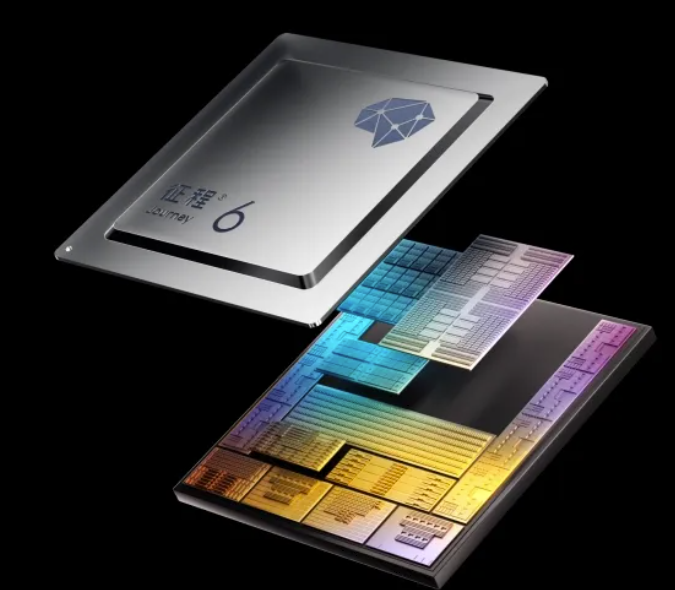
J6M and J6E respectively target mid-tier intelligent driving market’s inclusive urban cost-effective solutions and ultimate experience highway NOA solutions, providing SIP modules that comply with AEC-Q104 automotive standards and Matrix 6 domain controller reference designs, achieving lower power consumption and better system costs through high integration. In terms of computing power, J6M has 128 TOPS, same as J5.
J6P is quite critical, born specifically for the new generation of full-scenario intelligent driving, with six major characteristics: high integration, high computing power, high efficiency, high processing capability, high connectivity, and high security. A single J6P can support full-stack computing tasks including perception, planning and decision-making, and control. J6P’s maximum computing power reaches 560 TOPS, officially claimed that one chip equals two Orin-X chips. In its launched urban assisted driving system HSD, HSD 1200 corresponds to 300,000-yuan level models, equipped with 2 J6P chips, with computing power of about 1000 TOPS. This has certain correspondence with NVIDIA’s Thor-U chip in some high computing power demand scenarios. The J6 series has already secured platform-based mass production cooperation with over 20 automotive companies and brands, covering leading domestic automotive companies, internationally renowned automotive companies, leading new energy vehicle companies, joint venture automotive companies, etc.
The Sunrise series chips have significant characteristics of high performance and low power consumption, meeting the efficient operation needs of intelligent devices while effectively reducing energy consumption, which is crucial for some intelligent driving edge computing devices that need to work continuously for long periods. They are mainly applied in intelligent security and robotics fields, which will not be elaborated here.
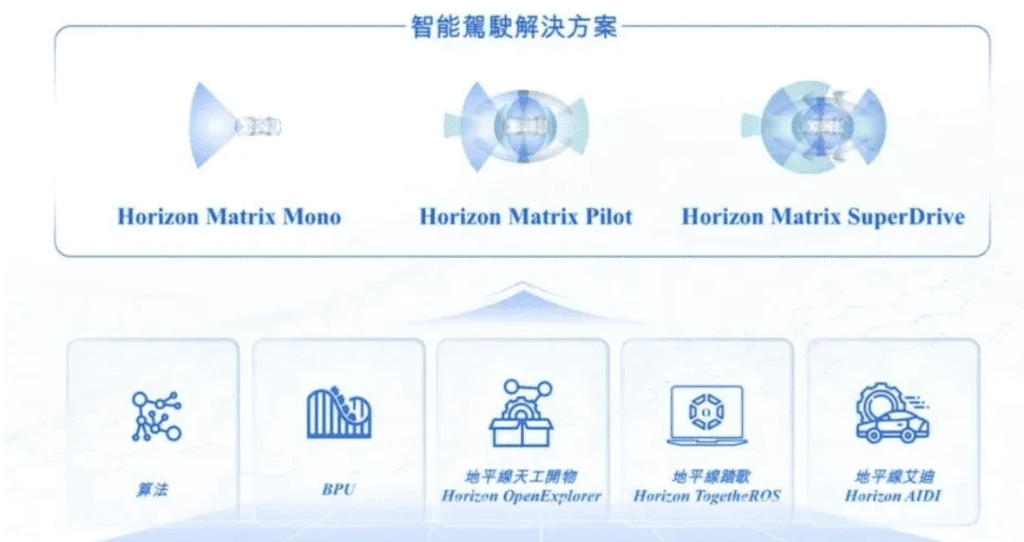
Now let’s look at the Matrix autonomous driving computing platform and Horizon SuperDrive full-scenario intelligent driving solution composed of chips:

The Matrix autonomous driving computing platform is an integrated hardware platform that integrates multiple Journey chips to meet different intelligent driving scenarios’ computing power needs. For example, Matrix 5 is equipped with 4 J5 chips, providing powerful computing support for vehicles to achieve complex intelligent driving functions. This platform has high flexibility and scalability, can be customized according to different automotive companies’ needs, and is widely applied in various intelligent driving vehicles, from passenger cars to commercial vehicles and other different types of vehicles can build intelligent driving systems based on the Matrix platform.
The Horizon SuperDrive full-scenario intelligent driving solution focuses on breakthroughs in human-like experience. With dynamic, static, and OCC three-network-in-one end-to-end perception architecture and data-driven interactive game algorithms, SuperDrive can balance scenario pass rate, traffic efficiency, and human-like behavior in operational scenario environments. In complex urban scenarios such as congested merging, intersection interaction-dynamic Driveline, yielding to cyclists, congested lane changes, and urban roundabout navigation, it can provide users with good intelligent driving experiences. For example, in congested lane change scenarios, data-driven interactive gaming can bring more human-like optimal solutions.
As Jensen Huang has emphasized on multiple occasions, NVIDIA is no longer just a chip company, and has even transcended the category of traditional technology companies, transforming into an AI infrastructure company. At the annual GTC conference, everyone can see that in Jensen Huang’s speeches, he spends a lot of time discussing the industrial logic of the AI inference era and NVIDIA’s importance as computing infrastructure, while the time spent introducing chip products is relatively shortened. This also conveys the message that NVIDIA’s core competitiveness is a complete AI infrastructure ecosystem.
Horizon follows the same logic. Besides chips and computing platforms, there is also a software ecosystem:
Development Tool Chain—Tiangong Kaiwu Model training tool chain, chip compiler, simulation testing platform. It can provide developers with a convenient development environment, help developers quickly conduct model training and optimization, and efficiently deploy trained models to Horizon’s chips. Through Tiangong Kaiwu, developers can utilize the hardware characteristics of Horizon chips to conduct targeted optimization of intelligent driving algorithms, improving algorithm operation efficiency and accuracy. For example, in the development process of intelligent driving perception algorithms, developers can use Tiangong Kaiwu for model training, and through its provided optimization tools, improve the model’s running speed on Journey chips by several times while reducing the model’s power consumption.

Vehicle Operating System—TogetherOS A real-time operating system designed to adapt to the heterogeneous computing architecture of Journey chips. It has single-chip multi-OS characteristics, capable of simultaneously being compatible with mainstream operating systems, with systems like Linux and Android all able to operate collaboratively within its framework. This characteristic enables vehicle devices to efficiently run different functional system modules on the same chip. For example, intelligent cockpit systems can achieve rich entertainment and interactive functions based on Android, while autonomous driving-related real-time control functions rely on Linux’s stability and real-time performance, greatly improving system integration and resource utilization. Meanwhile, TogetherOS uses lightweight virtualization technology to achieve multi-domain security isolation, safely isolating different functional domains of vehicles, such as power domain, chassis domain, cockpit domain, intelligent driving domain, etc., preventing interference and data leakage between different functional modules. For example, during intelligent driving, even if the intelligent cockpit system is attacked by malicious software, due to the multi-domain security isolation mechanism, it will not affect the normal operation of the autonomous driving system, ensuring vehicle driving safety.
It can fully leverage the hardware performance of Journey chips, achieving efficient task scheduling and resource management. In intelligent driving scenarios, vehicles need to process large amounts of data from sensors in real-time and make quick decisions. TogetherOS’s high real-time performance and good adaptability to heterogeneous computing architecture ensure that the system can respond to various tasks in a timely manner, guaranteeing stable operation of the intelligent driving system. For example, during vehicle operation, sensors generate large amounts of data per second, and TogetherOS can quickly schedule chip resources to process this data, enabling vehicles to respond promptly to changes in the surrounding environment.

Cloud Infrastructure—ADI Provides automotive companies and developers with cloud-based development resources and services, including computing resources, storage resources, and software development tools. Through Horizon ADI, developers can conduct large-scale model training and software testing in the cloud without deploying complex hardware facilities locally, greatly reducing development costs and time. Meanwhile, Horizon ADI also supports rapid iterative software updates, capable of optimizing and upgrading intelligent driving software based on actual usage data, improving software performance and user experience. For example, automotive companies can use Horizon ADI to collect data from vehicles during actual driving, optimize intelligent driving algorithms, and then quickly push updated software to vehicles through the cloud, achieving rapid software iteration.
Sensor Hardware Platform Launched in Early 2024—Qiuhao Through sensor solution selection, testing verification, and cost-quality control, it provides sensor hardware standard solutions that balance performance, cost, and reliability for intelligent vehicle mass production.
Horizon Qiuhao strictly controls sensor selection by cooperating with high-quality sensor suppliers to ensure that selected sensors can meet intelligent driving needs. Meanwhile, it conducts comprehensive testing and verification of sensors, including performance testing under different environmental conditions and reliability testing during long-term use. Through these measures, Horizon Qiuhao provides reliable sensor solutions for intelligent vehicle mass production, ensuring stable operation of intelligent driving systems. For example, when selecting camera sensors, Horizon Qiuhao comprehensively considers camera performance indicators such as resolution, frame rate, light sensitivity, as well as their reliability in harsh environments like high temperature, low temperature, and humidity, ensuring the most suitable camera selection solution for automotive companies.