
Li Auto Bets $280 Million on i8: Its Make-or-Break Electric SUV
The Make-or-Break Electric SUV Launch
“If the i8 fails too, Li Auto’s pure electric strategy will be proven wrong,” a long-term investor following Li Auto told us in mid-July.
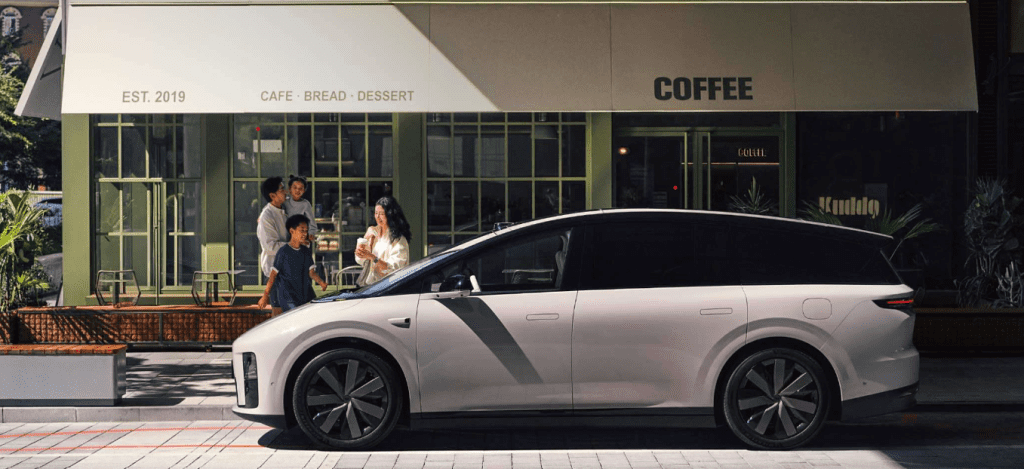
After a one-year delay, the i8 finally hit the market, shedding its initial design language that closely resembled the controversial MEGA MPV. Yet, its appearance remained a major talking point. But the discussion around this crucial vehicle extends far beyond its looks.
The Weight of Expectations
Internally, the i8 carries the burden of reviving team morale and repairing the damage from the MEGA’s disappointing launch. Externally, with tech giants like Huawei and Xiaomi aggressively entering the auto sector and dominating mindshare, Li Auto desperately needs a compelling pure electric product to solidify its position among the top domestic EV startups.
The i8 also serves as the ultimate test of Li Auto’s product development methodology. It must prove that the company’s highly refined approach, honed on its successful extended-range electric vehicles (EREVs), can be effectively translated into building competitive pure electric vehicles (BEVs).
The stakes are enormous. Back in February, just two leaked images of the i8 sent Li Auto’s Hong Kong stock soaring, adding over $28 billion USD to its market cap in a single day. In mid-July, announcing a pre-sale price range of $48,000-$56,000 USD caused another nearly 10% jump. Now officially priced between $44,200 and $50,800 USD, the i8, Li Auto’s first pure electric SUV, emphasizes six-seat spaciousness and ultra-fast “5C” charging – echoing the successful EREV formula of space + no range anxiety.
To win this must-win battle, CEO Li Xiang brought back key executives like Zhang Xiao and Liu Jie – architects of the successful ONE and L series – to lead the i-series development. Teams of thirty to forty people were reportedly “locked in meeting rooms daily” debating options until the final i8 design and features were settled. A month before launch, Li Auto further merged its Sales & Service group into a newly formed Smart Vehicle group led by President Ma Donghui.
“The i8 and upcoming i6 are so critical that Li Auto wants its most experienced executives overseeing them,” an insider explained. “This breaks down silos and allows faster adaptation to China’s brutally competitive auto market.”
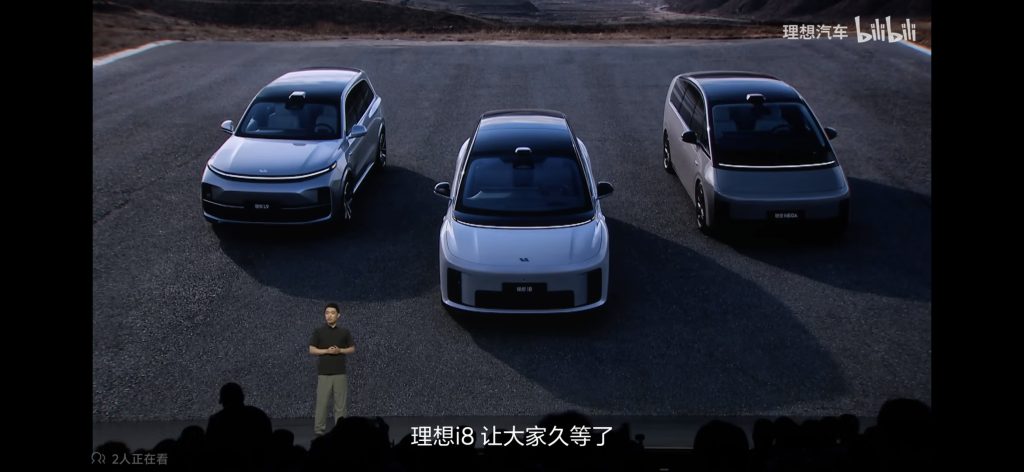
On the evening of July 29th, Li Auto hosted the i8 launch event at the Beijing International Convention Center near its R&D headquarters. Over 1,000 attendees witnessed what Li Xiang called “the largest venue and biggest launch event in the company’s history,” lasting over 90 minutes.
In the days leading up to the launch, we spoke with multiple Li Auto executives and key suppliers, documenting the series of critical trade-offs and adjustments this vehicle, originally conceived in 2021, underwent in its final stretch. Choices like prioritizing space over radical crossover looks, scrapping the front trunk (frunk), and tempering sales ambitions will soon be judged by the market: were they pragmatic innovations or another case of stubborn design?
Defining the Electric SUV Before Redesigning It
The aftermath of the MEGA’s underperformance and the lukewarm reception of the 2024 L-series plunged Li Auto into crisis in March. Zhang Xiao, President of the Second Product Line (who spearheaded the L8), recalled core managers meeting almost daily for over a month, gathering data and feedback to diagnose the core issues.
“There was panic,” Zhang Xiao admitted. “Some blamed the MEGA’s styling; others thought simply renaming the L-series would fix pricing dissatisfaction. It was chaotic, we even made some terrible suggestions.”
This intense soul-searching culminated in a consensus, summarized by Founder & CEO Li Xiang in an internal letter on March 21st. He cited two key mistakes: 1) Treating the MEGA’s nascent phase (0 to 1) like a growth phase (1 to 10), misjudging the validation period; 2) Letting sales targets override the company’s core strengths – user value and operational efficiency.
“That letter was the result of our deep dive,” Zhang Xiao stated. “We had to admit fault and explain ourselves to the public.“
This admission clarified the path forward. In early April, Li Auto merged its Product Development Teams (PDT) and Product Commercial Teams (PCT) into unified “Product Line” departments, all reporting to a renamed “Product & Strategy Group” (previously “CEO Office”).
“Around this reorganization, we basically identified the problems and knew how to tackle them,” Zhang Xiao said.
Under this new structure:
- First Product Line: Focuses on the 400,000 RMB+ market (L9, MEGA).
- Second Product Line: Targets 300,000-400,000 RMB.
- Third Product Line: Addresses 200,000-300,000 RMB (L6).
Zhang Xiao’s Second Product Line is Li Auto’s spearhead into the mainstream BEV market.
Li Auto’s veteran core team was deployed across three “fronts”: stabilizing the EREV L-series, ensuring the successful L6 launch, and “reviving” the struggling MEGA. Only by early May, after price cuts for the L-series and the successful L6 launch showed results, could the team finally focus on the BEV product line and the imminent i8.
The i8 project began in 2021. Unadjusted, it was slated for August 2024 production. The redesign debate initially centered on whether to alter the styling of both the MEGA and the planned pure electric SUV series (including the i8), but leadership lacked clear principles.
They elevated the question: Should the product matrix remain “two lines” (EREV L-series + BEV series) or become “three lines” (EREV + BEV + standalone MEGA)? This decision would fundamentally impact the i8 and the entire BEV line’s positioning.
After extensive debate, the team decided: Spin off the MEGA as a brand halo product, akin to the Mercedes G-Class, not chasing volume. Li Auto’s pure electric SUVs would form their own distinct product line.
This meant the planned “mini-MEGA” SUVs needed a new identity, distinct in name and design. “i” (for “intelligence”) replaced “M” as the new series name, combining with the EREV “L” to form “Li” (Ideal).
With direction set, execution became clearer: Visually differentiate the new i-series from the MEGA. Redesigning the already-styled i-series vehicles was the logical next step.
Product teams then poured energy into evaluating and selecting BEV SUV styling options.
They established three redesign principles:
- Strong Family Identity: Clear, recognizable lineage.
- Low Drag Coefficient: Maintain or achieve drag close to the original target.
- True SUV Styling: Retain classic SUV characteristics.
Based on these, designers proposed numerous i8 revisions. After multiple reviews and collective decisions, the final i8 styling direction was locked in by July 2023.
This was a costly decision. While the production i8’s changes seem concentrated on the rear, the entire body-in-white structure is interconnected. Altering the design meant scrapping existing hard tooling, creating new molds, and running multiple validation sets simultaneously to meet the deadline. The total cost of the redesign? Approximately $2.8 billion USD (20 billion RMB).
“Li Xiang played the decisive role in pushing this change,” Zhang Xiao noted, “because only he could truly make that call.“
Time Crunch: Veterans Return to the Front Lines
After taking charge of the i8, Zhang Xiao drove it almost daily for over a month, constantly sitting inside to scrutinize the user experience. He identified two major issues.
First, lack of distinct character. The i8 felt too similar to the L9 inside and out. Key features were missing (driver’s premium speaker, adjustable headrests, second-row tray tables). “The interior was nearly identical to the L9 then.” Despite looking structurally different, it drove like an L9. After benchmarking competitors, Zhang Xiao’s team recalibrated the driving dynamics aiming for a blend of luxury and sportiness akin to the BMW i7, even widening seat bolsters for better support.
Second, ergonomic missteps. The driver’s left footrest caused discomfort due to a tight angle. The root cause was a short L113 parameter (distance from front wheel center to brake pedal). Unable to move the firewall, the team optimized by slightly repositioning and flattening the footrest angle.
Zhang Xiao sometimes brought Li Xiang on test drives. As the ultimate arbiter of product feel, Li Xiang also made decisive calls on key i8 configurations.
For instance, the i8’s CDC (Continuous Damping Control) suspension was initially developed as a single-valve system. In October 2023, swayed by the perceived advancement of dual-valve tech, the team switched to a system similar to the 2025 L9 refresh. However, by May 2024, nearing final delivery, they reverted to single-valve – because Li Xiang found the dual-valve setup “felt terrible.”
“Reverting wasn’t simple,” Zhang Xiao explained. “It meant redoing supplier work, testing, and calibration.” But testing confirmed the single-valve delivered the desired “suspended, isolated” premium ride quality. “The dual-valve was like wearing skate shoes – great for lateral control but transmitted too much vibration daily. The single-valve is like cushioned sneakers.”
This experience prompted reflection on why the i8’s early issues arose. One reason echoed by Tang Jing, President of the First Product Line, was that after the L8 launch, key product executives like himself were pulled from frontline development to focus on organization and long-term strategy, leaving product development primarily under Li Xiang’s direct leadership.
“Around late 2022, Li Xiang called me… He said I should spend more time ‘building roads’ [infrastructure], not on details,” Tang Jing recalled in April. “By the MEGA, I hardly attended reviews. My product responsibility faded.”
The newer team members working with Li Xiang, while talented, “hadn’t paid their dues together, hadn’t built ‘Yan’an’ from scratch, hadn’t won battles together,” Zhang Xiao observed. They rarely challenged Li Xiang on product disagreements. This meant “Li Xiang became the ceiling,” and the team aimed only to meet the boss’s requirements, not to “exceed user expectations” as originally intended.
Zhang Xiao likened this to the fundamental difference between a founder-driven startup and a professionally managed company: performance divergence stems not just from capability but from the founder’s vision and personal investment.
Li Auto had paid a similar price before. Zhang Xiao recalled that in 2021, setting up a Shanghai office for BEV projects under a new team led to repeated mistakes as Beijing’s accumulated experience wasn’t transferred. The solution was restructuring teams by capability, not project, ensuring core projects stayed with the experienced Beijing core.
If the first misstep was due to inexperience, Zhang Xiao admitted the second occurred partly because “we got cocky.”
The i8’s “Have-it-All” Challenge and Shrinking Margin for Error
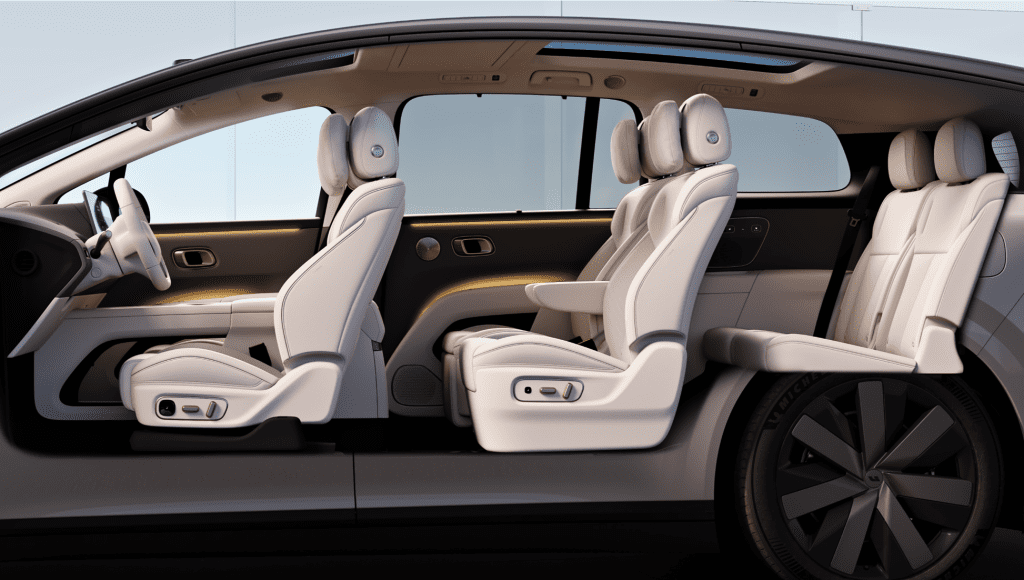
The i8’s core design philosophy – serving families upgrading from their first EV, needing both space and ease of driving – was set in 2021. Dubbed “8-series footprint, 9-series space,” it aimed for maximum interior room within a relatively compact exterior.
Passenger space was paramount. “Every seat, from first to third row, must be spacious,” Zhang Xiao emphasized. The side window sills were deliberately lowered and flattened to give third-row passengers a better view.
The BEV platform’s inherent advantage – space freed by removing the range extender – was crucial. Li Auto made a key decision: completely sacrifice the front trunk (frunk), dedicating all freed space to the cabin.
Zhang Xiao used a real estate analogy: “If you buy a 970 sq ft apartment, do you want all space for living areas, or 100 sq ft for storage? The frunk is that fixed storage room. For a six-seater, we give all space to the passengers.“
After ensuring space, aerodynamics became the focus. Targeting a drag coefficient close to the MEGA’s impressive 0.215 (and considering the original BEV family design), a MEGA-like aesthetic emerged, informed also by layouts like the Tesla Model X and FF 91. The subsequent rear redesign, still prioritizing space first and optimizing aero second (e.g., adding a cover over the wipers, ensuring flush windows), resulted in a slightly higher drag coefficient of 0.218.
Zhang Xiao described the i8’s development as moving from “a great raw space” (the BEV platform enabling low step-in height, wide openings, near-equal comfort across all rows) to “premium finishes” (details like zero-gravity seats, adjustable headrests, smart air vents enhancing comfort).
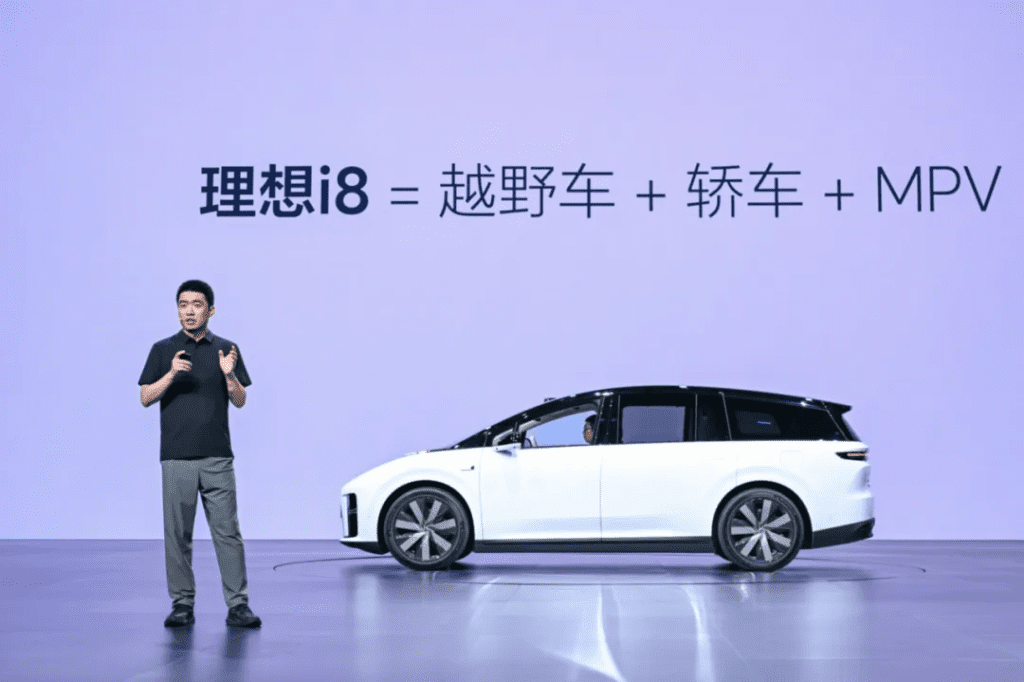
At the launch, Li Xiang proclaimed the i8 = SUV + Sedan + MPV. This crossbreeding attempt has a mixed history: it either creates a new market segment or becomes a commercial flop. Success hinges on platform suitability, clear positioning, and precise understanding of target users.
- Pontiac Aztek (Early 2000s): Aimed to blend SUV, minivan, and sedan. Doomed by being built on GM’s high, narrow U-platform (designed for minivans), forcing awkward compromises. Became a design laughingstock.
- Chrysler Pacifica (1st Gen, 2004): Marketed as a “Sport Tourer” (SUV+minivan+wagon). Failed because it was less practical than cheaper minivans; Chrysler lacked luxury credibility; shared Mercedes tech wasn’t promoted; plagued by reliability issues (engine mounts, transmissions).
- Lexus RX (1998): A success story. Toyota realized most SUV buyers didn’t off-road but wanted high seating, space, safety, and comfort without traditional SUV drawbacks. Built on a car-like unibody platform shared with the ES sedan, the RX delivered car-like comfort and handling in an SUV shape, creating the luxury crossover segment.
The i8 faces similar challenges. Li Auto’s strategy has swung from radical (early SEV project) to pragmatic (ONE & L-series success) back to overambitious (MEGA stumble), now seemingly returning to mainstream focus with the i8. Its opportunity lies in its native BEV platform serving Li Auto’s core space/comfort strength, coupled with 5C ultra-fast charging and its own charging network to address range anxiety. Whether its space, driving dynamics, and positioning resonate will be determined in the intensifying battle for the “large six-seat electric SUV” segment.
From Blitzkrieg to Marathon: Tempering Sales Ambitions
In April 2023, Li Xiang set wildly ambitious targets: declaring 2023-2025 as the “final three years” of China’s EV war, predicting 80%+ NEV market share by end-2025, and the rise of “NEV Big Five” brands. Two months later, he announced the goal: become China’s #1 brand in passenger vehicles priced over 200,000 RMB by 2025, selling 1.6 million units annually (up from 376,000 in 2023).
The initial 2024 target was 800,000 units, aiming for “China’s luxury sales crown.” Early 2024 saw Li Xiang predict smartphone-like market concentration in the 200,000 RMB+ NEV segment.
He underestimated automotive diversity. While phones serve relatively homogenous needs (communication, internet, photos), cars fulfill vastly different scenarios. Even among families, needs vary dramatically based on structure, location, climate, and income. Li Auto insiders privately admit pure EVs currently suit consumers in Eastern/Southern China best.
The MEGA’s underperformance shattered 2024 plans. A promised “big year” (1 EREV SUV + 4 BEVs) shrunk to just the MEGA and L6; the i8 and two other BEV SUVs were delayed. Full-year 2024 deliveries reached 501,000 – a 33.1% YoY increase, making Li Auto the first domestic brand to surpass 500,000 units in the 200,000 RMB+ segment – but far short of the 800,000 target.
This forced a strategic rethink. At a post-MEGA Spring strategy session, Zhang Xiao argued their previous assumptions about rapid market concentration were too optimistic. The competition would be a “protracted war,” requiring abandonment of both “defeatism” and “quick victory theories.”
The new stance: Maintain long-term confidence but acknowledge that industry competition and consumer adoption of new tech require a longer cycle. The market won’t consolidate as fast as Li Xiang predicted. “Don’t worry about survival, but ensure strong self-sufficiency and a healthy operational foundation to endure this cycle,” Zhang Xiao stated. Consequently, Li Auto stopped publicly announcing specific sales targets for 2024 and internally stopped using them to motivate non-sales teams.
Internal expectations for the i8 are now conservative. “We won’t set wildly ambitious targets for this car.”
At a late-May investor meeting, CFO Li Tie reportedly emphasized that overall BEV sales volume isn’t the immediate priority; the key is whether the i8 and i6 (due later this year) genuinely meet user needs. “We hope the market lowers its expectations, similar to before Xiaomi’s SU7 launch last year.” He stressed 2024 actions remain focused on user needs, not sales targets or BEV sales mix.
Reflecting this caution, Li Auto’s marketing approach shifted. On July 17th, it opened pre-orders for the i8 – a rare move for the company. Industry analysts saw this as testing market sentiment and gathering pricing intelligence due to uncertainty about the i8’s reception.
That same day, Li Xiang posted on Weibo, acknowledging most Chinese automakers use pre-orders; Li Auto lacks Xiaomi’s hype to skip them, nor Tesla’s brand strength to just launch online without any fanfare. Notably, following the MEGA backlash, Li Auto has reportedly tightened control over its founder’s public communications, signaling an internal correction to the previous laissez-faire approach.
While Li Auto claims a “0 to 1” mindset for BEVs, the i8’s journey feels more like a cautious “0.5 to 1” course correction. Its design still pushes boundaries but abandons the pursuit of “extremeness” seen in the MEGA.
The i8 has a coherent product logic based on its native BEV platform. But its challenge lies in communicating its strengths. The ONE and L-series succeeded through highly visible features. The i8’s space advantage requires in-person experience; its refined driving dynamics (benchmarked against the BMW i7) aren’t widely known; its low drag coefficient and quietness are quantifiable but less visceral than acceleration figures.
“The whole industry is becoming homogenous and dull,” Zhang Xiao observed. “Price is often the biggest weapon left.“
Competition won’t pause. On the very day i8 pre-orders opened, Tesla announced a long-wheelbase Model Y L for Fall 2024. Days later, on July 26th, AITO (Huawei-backed) opened pre-orders for the M8 BEV, claiming over 10,000 reservations in 8 hours. Simultaneously, Nio’s budget brand Onvo targeted price-sensitive families with its L90 starting under $27,500 USD (199,000 RMB) with battery subscription.
If Li Auto could previously joke that “at least the MEGA was recognizable,” the i8 doesn’t have that dubious distinction. Its success hinges purely on execution and resonating with pragmatic family buyers in an unforgiving market.