
China’s AI Meets Luxury: Mercedes Launches Momenta-Powered ADAS
I. Technology Implementation: End-to-End Large Models Reconstruct the ADAS Experience
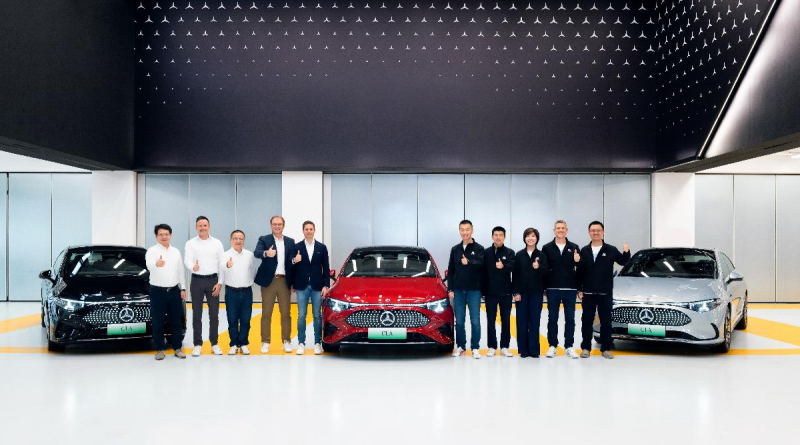
When Mercedes-Benz announced that its domestically produced all-new electric CLA would be equipped with the advanced driver assistance system (ADAS) co-developed with Momenta, it essentially marked the first mass-production collision between “luxury engineering standards” and “Chinese AI technology”. The core breakthrough of this solution, based on Momenta’s “Flywheel Large Model”, lies in the on-vehicle application of one-stage end-to-end technology — breaking the traditional modular architecture of perception, decision-making, and planning. It processes driving scenarios through a human-like brain mechanism of “long-term memory + short-term memory”, enabling the system to have stronger adaptability when dealing with complex road conditions in China.
From the perspective of practical application scenarios, its full-scenario coverage capability of “parking spot to parking spot” accurately addresses user pain points: Adaptive Cruise Control (ACC) and Lane Keeping Assist (LKA) on highways are already basic functions. On urban roads, the prediction of cut-in vehicles, decision-making for unprotected left turns, and recognition of irregular parking spaces in parking scenarios all rely on training with local Chinese driving data. Crucially, the system achieves a balance between safety and efficiency: it adheres to the “Mercedes-Benz Global Safety Standards” through designs such as yellow light running avoidance and preventive deceleration at intersections, while also improving traffic efficiency to a level close to human driving by learning local driving habits.
II. Eight Years of Deep Binding: The Evolution from Financial Investment to Strategic Symbiosis
The cooperation between Mercedes-Benz and Momenta is no coincidence, but an inevitable result of eight years of precipitation through four rounds of investment. When Daimler Group led the Series B1 round in 2017, it was more of a strategic layout for China’s intelligent driving track, making it the first international automaker to invest in a Chinese ADAS startup. After follow-up investment in 2018, Momenta’s valuation exceeded $1 billion, becoming a unicorn, and the two parties began to share technical resources. In the Series C financing in 2021, Mercedes-Benz joined hands with SAIC, Toyota and other automakers, marking the shift of cooperation from “technological exploration” to “mass-production binding”. The planned additional investment of $75 million in 2024, along with rumors of intent to make a cornerstone investment in the IPO, further highlights Mercedes-Benz’s long-term bet on Momenta’s technical route.
This dual binding model of “investment + R&D” has formed a win-win closed loop: Mercedes-Benz has obtained intelligent solutions tailored to the Chinese market without having to build a local data system from scratch; Momenta, on the other hand, polishes its technology with Mercedes-Benz’s engineering standards and opens up the international market through its global channels. Today, Momenta has secured orders from domestic and foreign automakers such as BBA, GM, and Toyota, which is a direct result of this strategic symbiosis.
III. Industry Shock: The Rise of China’s Paradigm in Luxury Car Intelligence Competition
The far-reaching impact of this cooperation goes beyond the product upgrade of a single enterprise and is reshaping the global intelligent driving competition pattern. First, it signifies the formation of “China dependence” for the intelligence of international luxury brands — following BMW and Audi, Mercedes-Benz’s entry means that BBA has collectively chosen Momenta as their technology partner in the Chinese market, breaking the previous technical prejudice of international automakers against local suppliers.
Second, Chinese intelligent driving enterprises are shifting from “technology output” to “standard participation”. The fact that Momenta’s end-to-end solution can pass Mercedes-Benz’s global safety certification proves that Chinese AI technology already has the ability to align with top international engineering standards, laying the foundation for other enterprises’ overseas expansion in the future. More notably, this cooperation model of “Chinese technology + international brand” may rewrite the competition rules of global intelligent driving: the technical standards previously dominated by Tesla and Mobileye are now facing challenges from Chinese solutions.
Conclusion: On the Eve of Industry Shuffle Amid the Mass-Production Wave
With the launch of the all-electric CLA this autumn, Momenta’s end-to-end technology will undergo large-scale market verification. For Mercedes-Benz, this is a key bargaining chip to cope with the impact of Tesla and new forces after its electrification transformation; for Momenta, it is a milestone in its evolution from a “supplier” to an “industry infrastructure provider”.
More importantly, this cooperation has opened a new entry point for the intelligence of luxury cars: when Chinese enterprises can not only provide technology but also output solutions tailored to local needs, the competitive focus of global intelligent driving has quietly shifted eastward. In the future, with the launch of more models, enterprises that lack local data accumulation and rely on traditional technical routes may face the risk of elimination in the new round of industry shuffle.I. Technology Implementation: End-to-End Large Models Reconstruct the ADAS Experience
When Mercedes-Benz announced that its domestically produced all-new electric CLA would be equipped with the advanced driver assistance system (ADAS) co-developed with Momenta, it essentially marked the first mass-production collision between “luxury engineering standards” and “Chinese AI technology”. The core breakthrough of this solution, based on Momenta’s “Flywheel Large Model”, lies in the on-vehicle application of one-stage end-to-end technology — breaking the traditional modular architecture of perception, decision-making, and planning. It processes driving scenarios through a human-like brain mechanism of “long-term memory + short-term memory”, enabling the system to have stronger adaptability when dealing with complex road conditions in China.
From the perspective of practical application scenarios, its full-scenario coverage capability of “parking spot to parking spot” accurately addresses user pain points: Adaptive Cruise Control (ACC) and Lane Keeping Assist (LKA) on highways are already basic functions. On urban roads, the prediction of cut-in vehicles, decision-making for unprotected left turns, and recognition of irregular parking spaces in parking scenarios all rely on training with local Chinese driving data. Crucially, the system achieves a balance between safety and efficiency: it adheres to the “Mercedes-Benz Global Safety Standards” through designs such as yellow light running avoidance and preventive deceleration at intersections, while also improving traffic efficiency to a level close to human driving by learning local driving habits.
II. Eight Years of Deep Binding: The Evolution from Financial Investment to Strategic Symbiosis
The cooperation between Mercedes-Benz and Momenta is no coincidence, but an inevitable result of eight years of precipitation through four rounds of investment. When Daimler Group led the Series B1 round in 2017, it was more of a strategic layout for China’s intelligent driving track, making it the first international automaker to invest in a Chinese ADAS startup. After follow-up investment in 2018, Momenta’s valuation exceeded $1 billion, becoming a unicorn, and the two parties began to share technical resources. In the Series C financing in 2021, Mercedes-Benz joined hands with SAIC, Toyota and other automakers, marking the shift of cooperation from “technological exploration” to “mass-production binding”. The planned additional investment of $75 million in 2024, along with rumors of intent to make a cornerstone investment in the IPO, further highlights Mercedes-Benz’s long-term bet on Momenta’s technical route.
This dual binding model of “investment + R&D” has formed a win-win closed loop: Mercedes-Benz has obtained intelligent solutions tailored to the Chinese market without having to build a local data system from scratch; Momenta, on the other hand, polishes its technology with Mercedes-Benz’s engineering standards and opens up the international market through its global channels. Today, Momenta has secured orders from domestic and foreign automakers such as BBA, GM, and Toyota, which is a direct result of this strategic symbiosis.
III. Industry Shock: The Rise of China’s Paradigm in Luxury Car Intelligence Competition
The far-reaching impact of this cooperation goes beyond the product upgrade of a single enterprise and is reshaping the global intelligent driving competition pattern. First, it signifies the formation of “China dependence” for the intelligence of international luxury brands — following BMW and Audi, Mercedes-Benz’s entry means that BBA has collectively chosen Momenta as their technology partner in the Chinese market, breaking the previous technical prejudice of international automakers against local suppliers.
Second, Chinese intelligent driving enterprises are shifting from “technology output” to “standard participation”. The fact that Momenta’s end-to-end solution can pass Mercedes-Benz’s global safety certification proves that Chinese AI technology already has the ability to align with top international engineering standards, laying the foundation for other enterprises’ overseas expansion in the future. More notably, this cooperation model of “Chinese technology + international brand” may rewrite the competition rules of global intelligent driving: the technical standards previously dominated by Tesla and Mobileye are now facing challenges from Chinese solutions.

Conclusion: On the Eve of Industry Shuffle Amid the Mass-Production Wave
With the launch of the all-electric CLA this autumn, Momenta’s end-to-end technology will undergo large-scale market verification. For Mercedes-Benz, this is a key bargaining chip to cope with the impact of Tesla and new forces after its electrification transformation; for Momenta, it is a milestone in its evolution from a “supplier” to an “industry infrastructure provider”.
More importantly, this cooperation has opened a new entry point for the intelligence of luxury cars: when Chinese enterprises can not only provide technology but also output solutions tailored to local needs, the competitive focus of global intelligent driving has quietly shifted eastward. In the future, with the launch of more models, enterprises that lack local data accumulation and rely on traditional technical routes may face the risk of elimination in the new round of industry shuffle.