

Xiaomi Group President Lu Weibing: Auto Business Targets Single-Quarter Profit in H2, Focuses on Blockbuster Products Rather Than Price Wars
Xiaomi Auto won’t engage in price wars; the goal of achieving single-quarter profit in H2 remains unchanged.
This afternoon, Xiaomi Group released its Q2 2025 financial report, showing smart electric vehicle business revenue of 20.6 billion yuan, with gross margin rising to 26.4% and operating loss of 300 million yuan, narrowing from 500 million yuan in Q1.
▲ Xiaomi Group releases Q2 2025 financial report
Additionally, Xiaomi Group Partner and President Lu Weibing further elaborated on Xiaomi Auto’s future strategy during the earnings call.
- Xiaomi Auto’s Q2 gross margin rose to 26.4%, with average vehicle price exceeding 250,000 yuan, benefiting from premium positioning and platform-based economies of scale, expected to maintain advantages with stable order support.
- Xiaomi Auto aims to achieve single-quarter or single-month profitability in H2, but due to cumulative investment of over 30 billion yuan in automotive business, overall profitability still needs time as it remains in the heavy investment phase with losses.
- Xiaomi Auto insists on not engaging in price wars, relying on efficient production and standardized platforms to reduce costs, focusing on creating competitive blockbuster products.
- Discussed Xiaomi Auto’s overseas expansion, proposing entry into European markets in 2027 as a “from difficult to easy” choice.
I. No Price Wars – Xiaomi Auto’s Brand Expansion Overseas Requires Building Brand Recognition
During the Q&A session of this quarter’s earnings call, Xiaomi management led by Lu Weibing provided detailed responses on topics including automotive business gross margin, profit targets, cost structure, and overseas strategy.
1. High Vehicle Prices and Order Scale Effects Boost Gross Margin
They first mentioned that this quarter’s EV gross margin reached 26.4%, with two core factors supporting this figure:
On one hand is Xiaomi Auto’s premium product positioning. Currently, Xiaomi Auto’s average vehicle price (approximately 253,000 yuan excluding tax, 286,000 yuan including tax) has entered the premium market segment, benefiting from the company’s strategic choice of premium market entry from the beginning.
On the other hand is the economies of scale brought by Xiaomi Auto’s platform approach. Models like Xiaomi SU7 and YU7 series share the same platform, achieving high modularity and standardization in production, centralizing supply chains, and reducing component procurement costs. Despite limited overall production capacity, the single platform scale remains large, creating significant cost advantages.
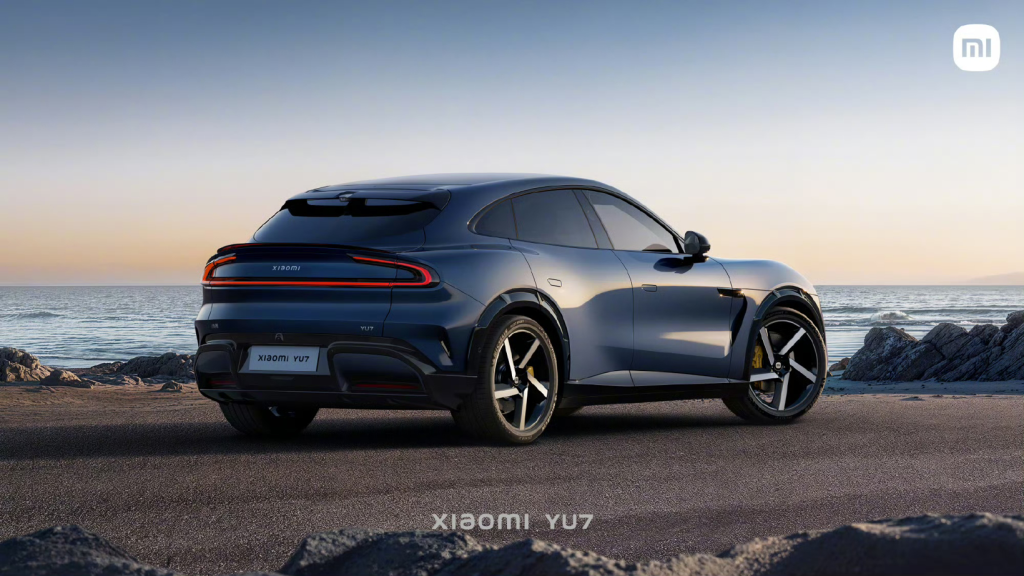
▲ Xiaomi YU7
Regarding gross margin sustainability, management candidly stated this depends on maintaining stable order volumes in the future. As long as product competitiveness is strong enough without relying on significant promotions, good gross margin levels can be maintained.
2. Automotive Business Maintains Unchanged H2 Single-Quarter Profit Target
Xiaomi Auto maintains its goal of “achieving single-quarter or single-month profitability in H2,” though whether this falls in Q3 or Q4 remains uncertain. However, as of H1 2025, Xiaomi’s cumulative investment in new businesses (including automotive) has exceeded 30 billion yuan, currently still in financial loss, and achieving cumulative profitability still requires considerable time, as this stage remains a period of large-scale investment.
3. Xiaomi Auto Focuses on Blockbusters, Doesn’t Participate in Price Wars
Cost-side changes are relatively controllable. Thanks to efficient production and platform development, no significant adverse variables are seen in the short term.
Xiaomi emphasizes that its automotive products will not participate in price wars or “involution,” but will focus on the products themselves, creating blockbusters and standardized platforms, continuously reducing costs through scale operations.
4. Overseas Market Expansion Plans Unchanged, 2027 European Market Entry
Xiaomi has set 2027 entry into the European automotive market as its target, currently in research and preparation phases. Currently, Xiaomi brand awareness in Europe is already considerable, but Xiaomi Auto’s brand recognition still needs cultivation.
Currently, Xiaomi is confident about this process, believing it can replicate the zero-to-one experience from the Chinese market.
Choosing to enter from the world’s most challenging market – Europe – is seen as a continuation of the company’s consistent “difficult first, easy later” strategy.
II. Continued Revenue Growth, Narrowing Losses, Per-Vehicle Revenue Exceeds 250,000 Yuan
From financial performance, Xiaomi Auto and AI innovation business performed well in Q2 2025, with smart electric vehicle revenue reaching 20.6 billion yuan, accounting for 96.7% of total innovation business revenue, growing 2.5 billion yuan from Q1’s 18.1 billion yuan, a sequential increase of 13.8%.
Meanwhile, operating losses for Xiaomi Auto and AI innovation business narrowed from 500 million yuan in Q1 to 300 million yuan.
In terms of gross margin, Xiaomi Auto and AI innovation business improved from 23.2% in Q1 to 26.4%, a gross margin level that exceeds many leading automakers.
From Q2 delivery performance, Xiaomi Auto delivered 81,302 new vehicles in Q2 2025, with per-vehicle revenue of approximately 253,000 yuan (calculated based on delivery volume), up 6.3% from Q1’s 238,000 yuan.
Using the 26.4% gross margin calculation, Xiaomi Auto’s gross profit per vehicle is approximately 53,700 yuan, higher than Q1’s 42,100 yuan, reflecting Xiaomi’s strong competitiveness in product pricing and cost control.
In R&D expenses, as of Q2 2025, driven by smart electric vehicles and AI innovation businesses, Xiaomi Group’s overall R&D spending increased 41.2% to 7.8 billion yuan compared to 5.5 billion yuan in the same period of 2024, with smart electric vehicle and AI innovation business operating expenses of 5.9 billion yuan.
In ESG aspects, Xiaomi Auto’s factory achieved over 6.9 million kWh of photovoltaic power generation in H1 this year, reducing carbon emissions by over 4,160 tons.
Conclusion: Xiaomi Auto Business Develops Steadily
Overall, Xiaomi is consolidating gross margins in the electric vehicle field through premium positioning and platform advantages, while adhering to long-termism and not sacrificing strategic pace for short-term market competition.
In global expansion, they intend to use proven models to address greater challenges and bring brand influence overseas.