

Chinese Vehicles in Military Parade: Competing for the Prime Position on Chang’an Street
“Troops under review, formation complete, please review.” General Han Shengyan, Commander of the Air Force of the Central Theater Command of the People’s Liberation Army and Commander-in-Chief of the parade, said loudly while standing on a Hongqi H7 produced by China FAW.
The reviewing leader standing on the opposite Hongqi CA7601J inspection vehicle had just driven out from the Tiananmen Gate Tower, passing through the Golden Water Bridge. He immediately issued the command: “Begin.”
On the morning of September 3, 2025, to commemorate the 70th anniversary of the victory of the Chinese People’s War of Resistance Against Japanese Aggression and the World Anti-Fascist War, China welcomed an unprecedented grand military parade.
This was the first parade since comprehensively advancing Chinese-style modernization entered a new journey, with all reviewed weaponry being domestically-produced active main battle equipment. In addition to the highly intimidating military equipment such as aircraft, tanks, and missiles, Chinese automobiles also received a comprehensive showcase opportunity.
During the founding ceremony parade on October 1, 1949, China did not yet have the capability to produce automobiles. Commander-in-Chief Zhu De, accompanied by Chief of General Staff Nie Rongzhen, reviewed the troops in a Soviet-gifted ZIS 110 convertible bulletproof sedan.
Previously, on March 25, 1949, to celebrate the relocation of the CCP Central Committee and PLA headquarters to Beiping, Mao Zedong conducted his first military review at Xiyuan Airport. At that time, he decided to use captured American Willys jeeps to review the troops.
It wasn’t until October 1, 1959, when the Hongqi CA72 appeared at the 10th anniversary National Day parade that national leaders’ inspection vehicles have all been Hongqi brand vehicles.
Not only China FAW’s Hongqi inspection vehicles, but this time passing before Russian President Putin’s eyes from the Tiananmen Gate Tower were also automobiles including Dongfeng Company’s Mengshi, BAIC Group’s Beijing, and a series of other Chinese brand vehicles.
In the early morning of September 2, for transportation from Tianjin to Beijing, Putin chose to travel by car. His vehicle was the Russian-made Aurus Kortezh, meaning “Golden Russia,” but this car contains numerous Chinese components. Chinese auto parts hold a 60% share in multiple categories of the Russian market.
At this special moment, major automakers also launched marketing campaigns. Hongqi said, “At important moments, there’s always a touch of red”; Mengshi said, “When the nation has major events, there must be Mengshi”; Beijing said, “Witnessing every step of prosperity”…
Behind the blood-stirring parade, Chinese automobiles have achieved a transformation from following to running alongside to beginning to lead over several decades.
1. A Touch of Red in the Parade

In 1958, China FAW developed the first domestically-produced passenger car named “Dongfeng Brand.” After Chairman Mao Zedong test-drove it in Zhongnanhai, he said happily: “We’re riding in our own little car now!”
Subsequently, the Central Committee required the First Automobile Manufacturing Plant to produce their own luxury sedans for central leaders and New China’s diplomatic envoys abroad. Thus, under harsh conditions, FAW workers hammered out the first Hongqi CA72 luxury sedan.
In 1959, at the 10th anniversary parade of the founding of the People’s Republic of China, domestically-produced vehicles appeared for the first time as parade vehicles. The debut of 10 Hongqi CA72 sedans attracted domestic and international attention.
Since then, Hongqi became a regular at parades.
The Hongqi CA770TJ at the 35th anniversary National Day parade in 1984 was the second-generation parade vehicle, the Hongqi CA772TJ at the 50th anniversary National Day parade in 1999 was the third-generation parade vehicle, while the Hongqi CA7600J at the 60th anniversary National Day parade in 2009 was the fourth-generation parade vehicle.
In 2015, the commemoration of the 70th anniversary of the victory of the Chinese People’s War of Resistance Against Japanese Aggression and the World Anti-Fascist War still used the Hongqi CA7600J. The Hongqi CA7601J at the 70th anniversary National Day parade in 2019 underwent upgrades and optimizations in electronic equipment, communication systems, suspension and chassis systems, belonging to the fifth-generation parade vehicle.
Hongqi inspection vehicles are classified vehicles at China FAW, with most information being confidential. However, regardless of which generation of Hongqi inspection vehicle, they all continue the first-generation Hongqi’s front grille fan-shaped design, round lights and cylindrical fender styling, palace lantern-shaped taillight design, and body lines running through front and rear.
The Hongqi CA7601J inspection vehicle is 6.4 meters long, 1.72 meters high when unloaded, 2.08 meters wide, with an engine being FAW’s independently developed V12 6.0 engine. The leader’s inspection vehicle is bulletproof, weighing 4.5 tons. The inspection vehicle adopts a fixed inspection platform, with inspection handrails determined according to the leader’s height and adjustable within an 80-millimeter range.
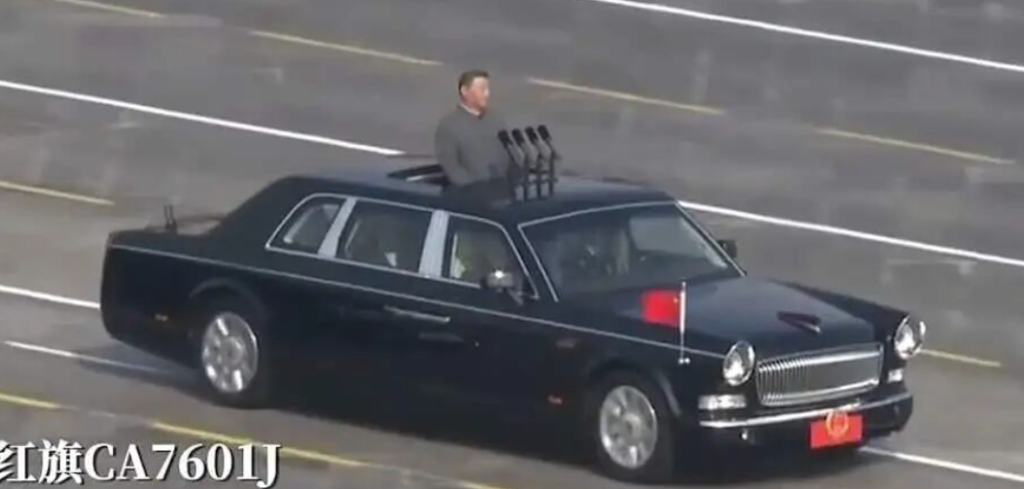
It’s worth noting that in 2015, when the Hongqi CA7600J appeared as an inspection vehicle, it didn’t display license plates but suspended the national emblem instead, for the first time in 66 years. Ten years later, on September 3, 2025, the head of state’s inspection vehicle still suspended the national emblem, but the two Hongqi vehicles behind him displayed license plates with the numbers 2025 and 1945 respectively.
In 2009, when media inquired about the CA7600J’s price, Jiang Hongjun, the chief engineer of the Hongqi inspection vehicle project at the time, didn’t give specific figures, only saying: “This vehicle is positioned at the same level as the Rolls-Royce Phantom, Maybach 62, and Bentley Arnage 728.”
Market rumors suggest the CA7600J’s price was 8 million yuan. On April 18, 2023, China FAW launched the Hongqi Golden Sunflower sub-brand based on the national car, with the logo being a “golden sunflower,” symbolizing “harmony and prosperity,” positioned alongside Rolls-Royce Phantom and Bentley Arnage as China’s own top luxury brand.
The Hongqi Golden Sunflower series currently mainly includes the Guoli starting at 7.18 million yuan, the Guoya priced between 1.4 and 1.86 million yuan, the SUV model Guoyao priced between 1.36 and 1.46 million yuan, and the Guoyue with 17 to 23 seats replacing the Coaster, totaling four vehicle models.
Automotive Business Review learned that currently, vehicles for receiving foreign guests in national diplomatic activities are usually the new Hongqi H9, Hongqi HQ9, and Hongqi Guoyue models. Among them, Hongqi H9 undertakes point-to-point reception tasks for important VIPs, Hongqi HQ9 is the preferred choice for delegation group travel, and Hongqi Guoyue specifically handles core travel tasks for heads of state and important delegations.

Currently, Chinese national leaders usually travel in Hongqi L5 or Hongqi L3 models when visiting abroad. On November 15, 2023, local time, the Chinese and American heads of state met at the Filoli Estate in San Francisco. After the meeting, President Biden personally escorted the guest to the boarding area, pointed to the car beside the Chinese leader and said, “This car is beautiful.” The Chinese leader smiled and responded, “Hongqi car, domestically made.”
2. China’s Top Military Vehicle Brand

If China FAW’s Hongqi excels in prestige, Dongfeng Company’s Mengshi wins with quantity.
In the “September 3 Parade” formation segment, the parade formation comprised 45 formations (echelons), with 115 Dongfeng “Mengshi” military vehicles produced by Dongfeng appearing as “front-runners” in the parade once again.
In 1965, due to national defense construction needs, the Second Automobile Manufacturing Plant (predecessor of Dongfeng Company), which was still under construction, received the task of developing and producing military two-ton off-road vehicles — the 20Y.
In 1975, Dongfeng Company’s independently innovated first-generation military vehicle EQ240 was completed and put into production. In 1979, the EQ240 carried people’s soldiers to the battlefield of the Self-Defense Counterattack War against Vietnam. Due to excellent product quality and outstanding performance, Dongfeng military vehicles became famous in one battle, earning merit and being hailed as “meritorious vehicles” and “heroic vehicles.”
In the mid-1990s, the Dongfeng EQ2102, equipped with new high-power diesel engines and higher passability, opened the history of Dongfeng’s second-generation military vehicles serving national defense and has continued as a main transport vehicle type to this day. Dongfeng also became China’s main military vehicle production base.
With military vehicle blood flowing through it, from 1984 to 2025, Dongfeng automobiles have driven through Tiananmen Square in every parade, witnessing the strong steps of a great nation’s military.
- 1984 35th anniversary National Day parade: 48 Dongfeng military vehicles were reviewed, including 2.5-ton off-road vehicles, 3.5-ton off-road vehicles, and wheeled armor with engines produced by Second Auto Works;
- 1999 50th anniversary National Day parade: 95 Dongfeng vehicles successfully passed through Tiananmen, including 64 military vehicles and 31 parade floats;
- 2009 60th anniversary National Day parade: 83 Dongfeng military vehicles participated in the review, including 43 Dongfeng Commercial Vehicle EQ2102 series and 40 Dongfeng Mengshi EQ2050 models;
- 2015 commemoration of the 70th anniversary of victory in the Chinese People’s War of Resistance Against Japanese Aggression and World Anti-Fascist War parade: 118 Dongfeng military vehicles were reviewed, including 105 Dongfeng Mengshi and 13 Dongfeng EQ2102N models, accounting for about one-third of total parade vehicle equipment, ranking first among all reviewed automobile brands;
- 2017 parade celebrating the 90th anniversary of the founding of the People’s Liberation Army: 187 Dongfeng military vehicles were reviewed, accounting for one-third of all participating vehicle equipment.
- 2019 70th anniversary National Day parade: 135 Dongfeng military vehicles were reviewed, appearing as “front-runners” in equipment formations, including 115 Dongfeng Mengshi and 20 Dongfeng Commercial Vehicle EQ2102N models.
On September 3, 2025, a total of 115 Dongfeng “Mengshi” vehicles participated in the parade, with 89 officially reviewed vehicles. Twenty-five Dongfeng “Mengshi” formed one “integrated formation” battle flag formation; 24 Dongfeng “Mengshi” participated in 5 “organized formations,” including anti-drone formation, cyberspace warfare formation, information support formation, equipment support formation, and logistics support formation; the remaining 40 Dongfeng “Mengshi” guided 20 ground wheeled equipment formations.
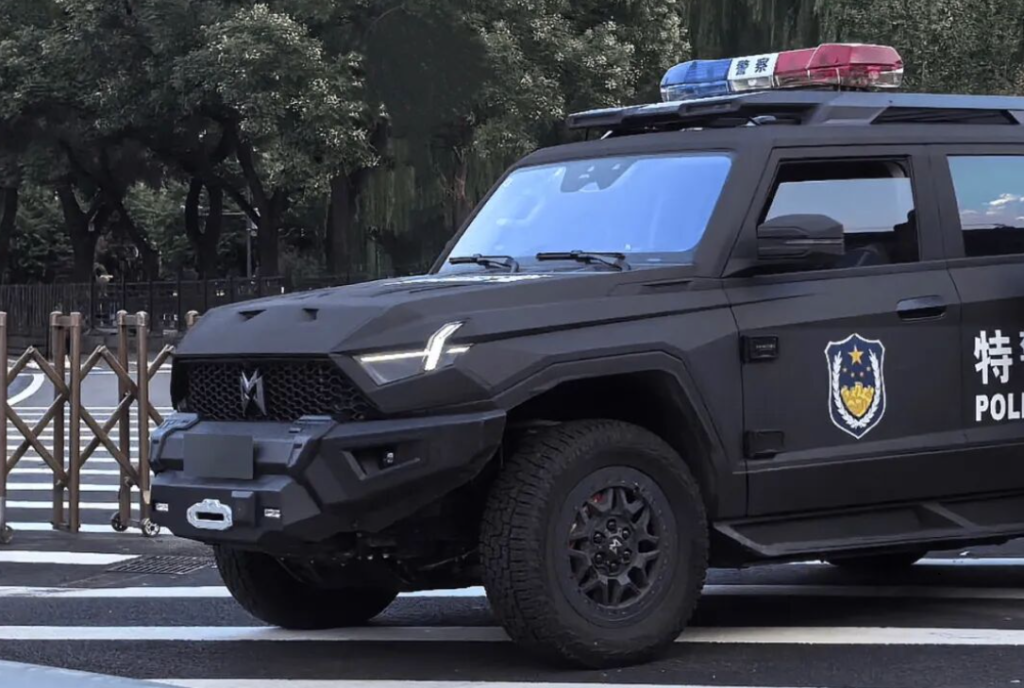
Outside the parade ceremony, Dongfeng Mengshi Technology’s flagship work — the Mengshi 917 — was also deployed for parade support duties. Multiple Mengshi 917 anti-ramming barrier vehicles were equipped to relevant duty forces, shouldering key tasks such as daily protection of Tiananmen Square, key area security duties, and “September 3 Parade” security protection.
“This is my honor, and even more so Dongfeng’s honor!” National People’s Congress representative, national model worker, Dongfeng Commercial Vehicle Vehicle Factory special-grade technician and chief engineer Wang Jianqing was invited to observe the ceremony at the parade site.
He said: “When Dongfeng military vehicles I personally participated in manufacturing drove past in formation, pride and responsibility instantly overflowed. Strong nation’s heavy equipment includes our Dongfeng — this is not just a slogan, but a promise forged by Dongfeng with military-grade quality as foundation and crafted with craftsmanship.”
3. Chinese Vehicles in the Parade

In the 2025 September 3 parade, 61 BJ80 vehicles from Beijing Off-road under BAIC Group appeared neatly once again, participating as ceremonial cannon tractors and news support vehicles.
Tracing the history of Beijing Off-road’s participation in national events, the most glorious moment was in 1966 when Chairman Mao rode in a Beijing BJ212 to review gathered masses at Tiananmen Square. In the 35th anniversary National Day parade in 1984, this vehicle again accepted review as a guide vehicle.
BAIC Group has had a tortuous history, with its glorious years reopening in the 2010s.
In 2015, 58 Beijing BJ40 vehicles participated as ceremonial cannon tractors in the commemoration of the 70th anniversary of victory in the Chinese People’s War of Resistance Against Japanese Aggression and the World Anti-Fascist War.
On July 30, 2017, at the parade celebrating the 90th anniversary of the founding of the Chinese military held at Zhurihe Training Base — the first special parade themed on celebrating Army Day — Beijing Automobile BJ80 inspection vehicles became the new vehicle for the Military Commission Chairman. In the same year’s Hong Kong return 20th anniversary celebration, Beijing Automobile BJ80 also appeared as inspection vehicles in the public eye.
In 2019, at the parade for the 70th anniversary of the founding of the People’s Republic of China, BJ80 off-road vehicles served as inspection vehicle equipment;
In 2021, at the 100th anniversary of the Party’s founding celebration, BJ80 served as ceremonial cannon tractors.
Reviewing Beijing Automobile’s development journey, since undertaking the responsibility of developing military off-road vehicles for the troops in the early 1960s, from BJ210C and BJ212 to Warrior and BJ40, generations of vehicle models have continuously evolved.
As the inventor of Chinese off-road vehicles, Beijing Off-road has always resonated with national development, repeatedly serving as presidential parade vehicles, inspection vehicles, ceremonial cannon tractors, and undertaking six Shenzhou spacecraft escort missions, as well as consecutively serving as Everest surveying support vehicles.
In this September 3 parade support mission, Foton Auman under BAIC Group served as support vehicles for peace dove transportation and release tasks, completing peace dove release tasks at Tiananmen Square for the 14th time; BAIC Foton Aumark provided high-quality passenger shuttle services for military personnel, police, university chorus groups, volunteers, and other staff, as well as guests from various units.
BYD participated in this parade in another way. Before the September 3 parade officially began, 23 BYD pure electric sanitation vehicles T18 from Beijing Environmental Sanitation Group conducted sweeping operations on Chang’an Street. This was BYD’s third time undertaking national-level parade environmental sanitation support tasks, with the previous two being the 2015 “September 3 Parade” and the 2019 70th anniversary National Day celebration.
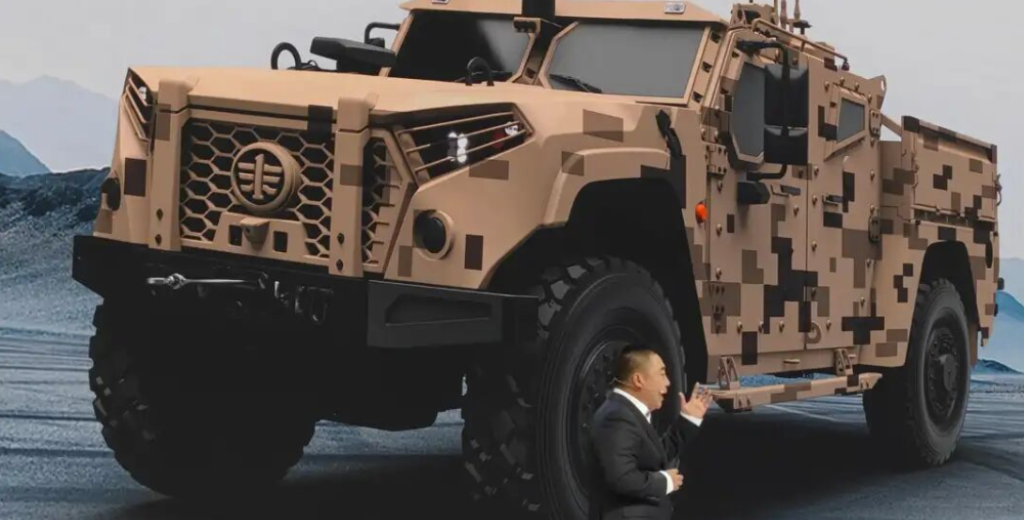
In this September 3 parade, besides the Hongqi brand, China FAW also had FAW Jiefang heavy trucks in the information support formation, as well as FAW MV3 medium high-mobility general tactical vehicles. The FAW MV3 is a modern new medium (3.5-ton class) truck that meets stringent indicators in eight areas: mobility, survivability, environmental adaptability, supportability, testability, electromagnetic compatibility, and reliability, and can be modified into various purpose vehicles.
Beiben Heavy Truck’s VP-23 armored transport vehicles and China National Heavy Duty Truck’s HOWO series trucks also appeared at the parade site carrying anti-ship and ship-to-air missiles. The integrated self-loading fuel trucks and airport comprehensive support vehicles in the parade logistics support formation were also built on the Heavy Truck HOWO platform. Additionally, Shaanxi Automobile Heavy Truck drove through Tiananmen Square for the seventh time since first appearing in the 1984 National Day parade.
The hour-and-a-half September 3 parade passed in an instant, but the great nation’s heavy equipment at the parade demonstrated China’s strength to the world, leaving the world with lasting memories. Those Chinese automobiles at the parade were equally a demonstration of China’s strength, even possessing more enduring power, and they are only a small part of Chinese automobiles.
Source:https://inabr.com/news/21801