
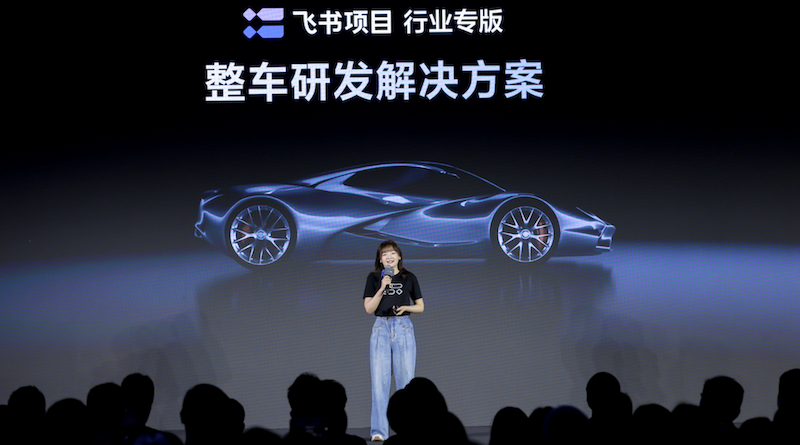
ByteDance-owned Lark Breaks into Car-Making Business with Launch of Full-Vehicle R&D Solution
China’s domestic auto market is currently experiencing an unprecedented “new car boom.” Harmony Intelligence Auto launched three new models in a single day, and Li Auto’s iteration pace remains tight—shortly after releasing its all-electric model i8 a month ago, spy shots of the suspected Li Auto i9 road test have gone viral online even before the launch of its new all-electric SUV i6. Data shows that in the first seven months of 2024, the auto industry launched a total of 88 new models, marking the highest number of new car launches in nearly four years. Behind this “new car battle” lies a fundamental shift in automotive R&D logic: competition has moved from traditional powertrain performance to a focus on intelligent capabilities. However, the exponential increase in complexity brought by intelligent R&D, coupled with the accelerating pace of market launches, is forcing automakers to revolutionize their R&D models. Against this backdrop, Lark Project’s launch of a full-vehicle R&D solution provides a key path for the industry to address the four core challenges of “speed, quality, coordination, and innovation.”
I. Industry Pain Points: The “Complexity Dilemma” of Smart Car R&D
Automotive R&D has transitioned from the “mechanical era” to the “intelligent era,” with R&D focus shifting to software-hardware collaboration. However, its complexity far exceeds that of traditional models, primarily reflected in three aspects:
- Exponential Growth in R&D Scale
A smart car contains hundreds of millions of lines of code. The breakdown of a secondary project for a single vehicle model involves tens of thousands of tasks and thousands of deliverables, requiring integration of resources from hundreds of suppliers. The cross-departmental and cross-enterprise collaboration chain is extremely long. - Mismatch Between Traditional Models and New Demands
In the past, automakers relied on “human-tracked task” management. Faced with changing consumer needs and software-hardware integrated development models, issues such as broken demand transmission, out-of-control project progress, and delayed quality control frequently occurred. Once collaboration stalled, the consequences ranged from project delays and cost overruns to outright market elimination. - Low Reusability of Technical Assets
Core technical assets such as intelligent driving algorithms and software modules lack platform-based management, making efficient sharing across different vehicle models impossible. This leads to repeated development, resource waste, and low software update efficiency, further slowing down R&D progress.
As William Li, Chairman and CEO of NIO, stated, “Car manufacturing is essentially about managing complexity,” and Yin Tongyue, Chairman of Chery Holding Group, emphasized that “process innovation takes precedence over product and technological innovation.” The industry’s demand for R&D models capable of handling high complexity has become increasingly urgent, while traditional R&D tools can no longer meet these needs.
II. Lark’s Breakthrough: The “Four Core Capabilities” of Full-Vehicle R&D Solutions
Based on in-depth insights into industry pain points and experience in manufacturing IPD (Integrated Product Development) solutions, Lark Project has launched a full-vehicle R&D collaboration solution specifically designed for smart car R&D. Focusing on the four major challenges of “difficult task breakdown, slow cross-departmental collaboration, high quality risks, and opaque overall progress,” it achieves “precision, efficiency, stability, and visualization” in R&D management through four core capabilities:

| Core Capability | Specific Functions | Pain Points Addressed |
|---|---|---|
| Architecture Integration | Breaks down tasks via a 10,000-line schedule, enables multi-level process linkage and real-time status synchronization, and accurately assigns full-vehicle R&D tasks to individuals with end-to-end traceability. | Chaotic task breakdown, broken demand transmission, and asynchronous information across links. |
| Project Collaboration | Builds a multi-level planning system (“big pictures” such as swimlane diagrams and schedules) to clarify goals at each node; establishes an “R&D technical asset platform” where over 300 standardized technical modules can be reused and automatically updated. | Disorganized cross-departmental collaboration, inability to share technical assets, and excessive repeated development. |
| Quality Control | Embeds quality checkpoints and automated review processes; uses a “case library” to warn of risks in advance, blocks non-compliant items during development, and automatically generates work orders for closed-loop handling afterward; integrates AI to optimize quality inspection. | Reliance on “post-fault fixes” for quality issues and high labor/time costs. |
| Overall Visibility | Provides real-time visual dashboards, allowing users from engineers to CEOs to monitor progress, identify risks, and make data-driven decisions. | Opaque overall progress, preventing management from promptly grasping project dynamics. |

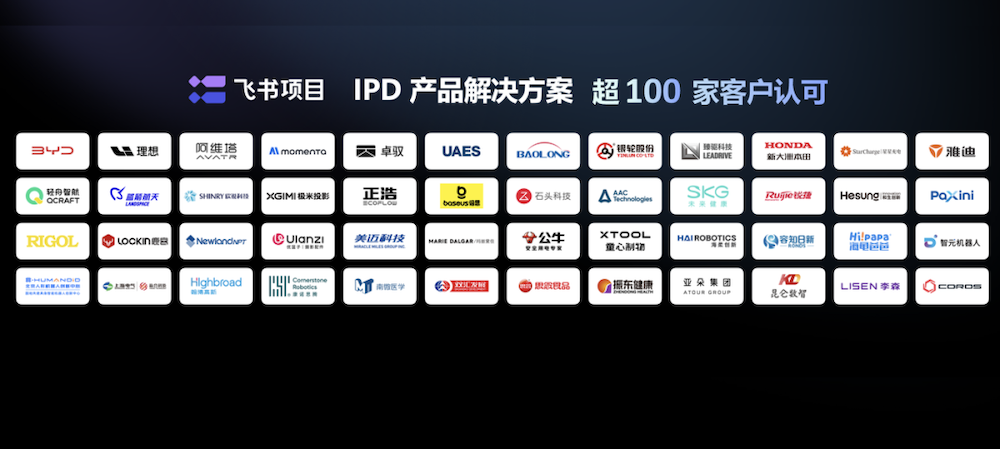
Lark’s confidence to enter this “hell-difficulty” scenario stems from its solid industry accumulation: in the SaaS field, it holds a 37% market share in software project management and serves over 100 enterprises with its IPD solutions; two-thirds of the top 30 domestic automakers by sales (including Li Auto, NIO, XPeng, and BYD) have partnered with Lark. Avatr has even operated stably on its solution for nearly a year, and He Xiaopeng, Chairman and CEO of XPeng Motors, has publicly recognized Lark’s role in integrating XPeng’s system capabilities.
III. Practical Verification: The “Qualitative Leap” in Avatr’s R&D Efficiency
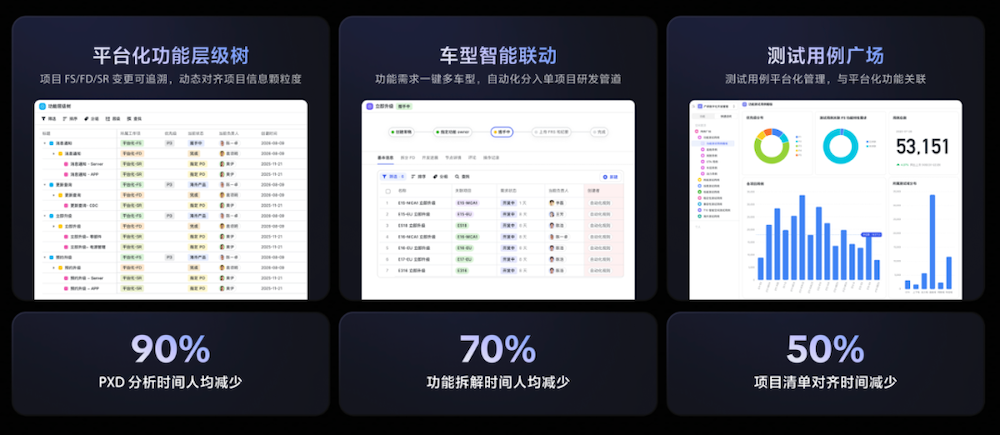
In August 2024, Lark and Avatr launched their collaboration, and part of the solution was put into use in just two months, leading to a significant improvement in R&D efficiency: per capita PXD analysis time was reduced by 90%, vehicle deliverable approval efficiency increased by 30%, per capita software function breakdown time decreased by 70%, and project function list alignment time was cut by 50% . Behind this achievement are three major transformations brought by Lark’s solution to Avatr’s R&D model:
- “Distortion-Free Transmission” from Demand to Execution
The system automatically collects and merges user needs, breaks them down into specific development tasks, and connects them to corresponding links with full traceability. This ensures that R&D outcomes accurately match user expectations and avoids resource waste. - “Transparent Management” of Project Coordination
Through the “big picture” of the multi-level planning system, management can gain a comprehensive view of overall progress at a glance and dive into details (who is doing what, when it will be completed, and where bottlenecks lie), eliminating “disorganized accounts” entirely. - “Full-Process Prevention and Control” of Quality Management
Shifting from “post-fault fixes” to “pre-warning, in-process blocking, and post-closed-loop handling,” combined with AI-powered quality inspection, it significantly reduces quality risks and labor costs.
As Zhang Lei, Head of Process and IT at Avatr Technology, noted, Lark’s solution has completely changed the traditional “human-tracked task” model, enabling “automatic process flow.” It breaks down departmental silos, reduces redundant communication, and allows the system to “assist work and help avoid pitfalls.”
IV. Conclusion: R&D Efficiency Improvement—A “Survival Must” for the Auto Industry
In the increasingly fierce competition in the smart car sector, R&D efficiency and quality directly determine an automaker’s market position. The launch of Lark’s full-vehicle R&D solution not only provides automakers with a tool to handle high-complexity R&D but also opens up this proven capability to the entire hardware manufacturing industry, offering a reference for the digital transformation of manufacturing.
From an industry perspective, “process automation, asset platformization, quality intelligence, and management visualization” will become the core directions of R&D management. For automakers, choosing a suitable R&D collaboration tool and breaking free from the constraints of traditional models are essential to gain a foothold in the “new car battle” and achieve the leap from “fast new launches” to “efficient and high-quality new launches”—this is not just a need for efficiency improvement, but a must for survival.