

The Transformation and Strategy of Black Sesame Intelligence: From a “Substitute” to a “Rule-Definer”
I. Strategic Positioning: The Leap from “Substitute” to “Rule-Definer”
Many Chinese chip companies originated from the logic of “domestic substitution”—that is, under existing technical frameworks and market rules, they gain a share of the market through advantages in cost, services, or supply chain security. However, Black Sesame Intelligence has made a more radical and forward-looking choice:
- Pioneering the “Uncharted Territory”: In the field of high-level intelligent driving chips, there is “nothing to copy” because there are no mature solutions globally. This forces the company to engage in Original Innovation from day one. For instance, its heterogeneous architecture SoC design and early hardware support for Transformers are all efforts to define a new set of technical rules.
- Upgrading the Competitive Dimension: While the industry is trapped in internal competition over “computing power (TOPS)” and “single-chip price”, Black Sesame Intelligence has changed the game rules through the “system-level cost reduction” of its Wudang series and the “computing power efficiency” of its Huashan series. Competition is no longer merely a battle of chip parameters, but an upgrade to a competition of system-level solutions that help customers (automakers) build more competitive vehicles. This has transformed the company from a pure chip supplier into an “enabler of intelligentization”.
II. Evolution of Ecological Philosophy: From “Delivering Chips” to “Delivering Innovation Capabilities”
It has become common for chip companies to talk about ecological construction, but Black Sesame Intelligence’s approach reveals a deeper ecological philosophy:
- The Dialectical Unity of Open Source and Barriers: It dares to open-source some algorithms and deliver them in a white-box manner. Although this seems to weaken barriers, the opposite is true. This lowers the cooperation threshold for top-tier customers (especially automakers with self-developed algorithms) and enhances stickiness. Its true barriers lie in the foresight of hardware architecture and the depth of software-hardware collaborative optimization. As Shan Jizhang put it, when algorithms iterate rapidly, only hardware laid out in advance can keep up. This strategy of “opening up software and locking in hardware platforms” is similar to the Android model in the mobile Internet era.
- Co-Creation as the Only Path in Cutting-Edge Fields: In the uncharted territory of technology, no single party can anticipate all problems. The “cross-domain co-creation” emphasized by Black Sesame Intelligence is its core methodology. This is not just customer service, but Joint R&D. Through in-depth binding with leading automakers and Tier-1 suppliers, it can obtain the most cutting-edge demands at the earliest, feed them back into chip definition, and form a rapid positive cycle of “demand-innovation-verification”—an advantage that traditional chip giants with long cycles can hardly match.
III. Logic of Market Expansion: From “Supply Chain Security” to “Value Output”
In the early days, geopolitics and supply chain security issues caused by the “chip shortage” were important considerations for domestic chips to enter the automaker supply chain. However, the case of Black Sesame Intelligence shows that the next stage must achieve a transformation to “value output”:
- Domestic Market: Proving with Value, Not Just Identity: As more domestic chip options emerge, automakers’ choices are returning to commercial rationality. The hot sales of models equipped with Black Sesame Intelligence’s chips (such as Geely Galaxy) are the most powerful proof of its product value. It has proven that domestic chips can not only “be used” but also help automakers build best-selling models. This is the confidence behind its goal of capturing 30% of the market share.
- Overseas Strategy: Reverse Innovation and Capability Spillover: Its overseas strategy (with a 10% market share target) is not a simple sales expansion, but a form of “capability spillover”. China has the world’s most competitive and fastest-iterating intelligent automobile market; the products, algorithms, and engineering experience honed here are themselves a form of “dimension-reducing strike”. The overseas expansion process requires adaptation to local scenarios, but its core is a proven advanced solution. This is similar to the overseas expansion of Chinese Internet models—it is about promoting the standards and rules of Chinese innovation to the global market.
IV. Thoughts on “Embodied Intelligence”: The Science and Art of the Second Growth Curve
Expanding its business into the field of robots (embodied intelligence) is by no means a simple concept hype, but based on in-depth industrial judgment:
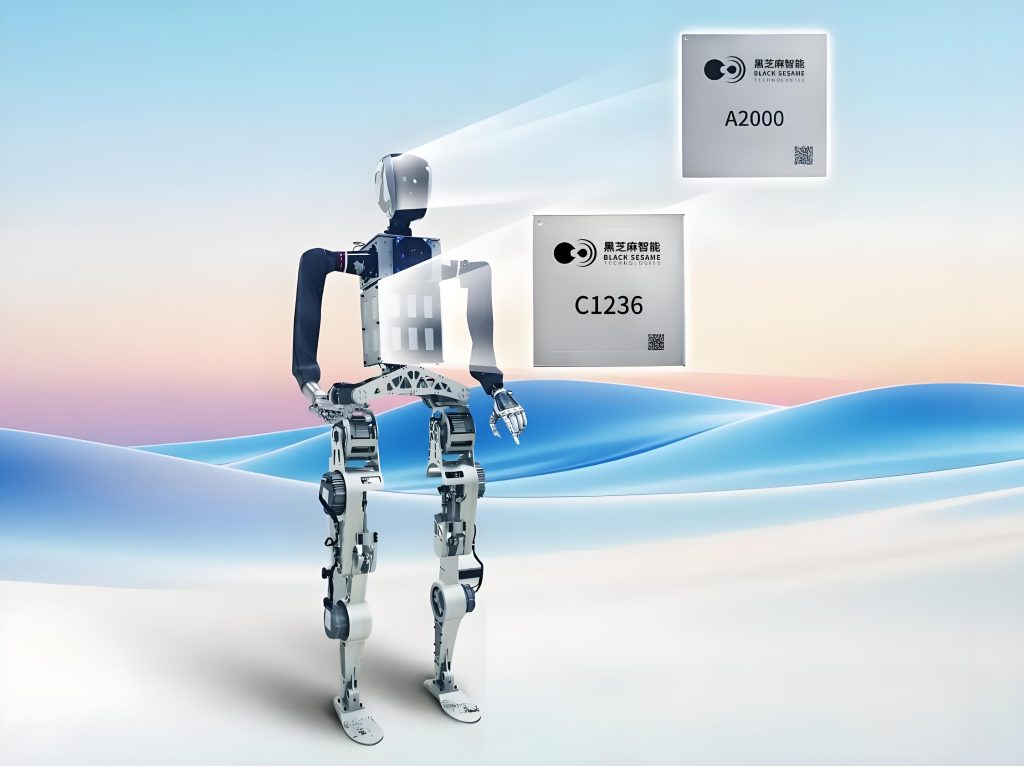
- The Inevitability of Technological Homology: The “brain” (environmental perception and decision-making) and “cerebellum” (motion control) of robots have a high degree of overlap with intelligent automobiles in terms of technology stack. Black Sesame Intelligence’s two product lines (Huashan series as the “brain” and Wudang series as the “cerebellum”) perfectly cover these needs. This enables it to enter the new field with extremely low marginal costs and high technology reusability.
- Accurate Positioning in the Market Cycle: Shan Jizhang acknowledges that the current robot market “has not yet fully taken off”, but the company is laying out in advance. This replicates its successful experience of deploying high-computing-power chips in 2018—preparing mature products for the upcoming surge in demand at the right time. This accurate judgment of the Gartner Hype Cycle (Technology Maturity Curve) is a core capability of CEOs of top technology companies.
V. Challenges and Future Tests
Despite its clear strategy, Black Sesame Intelligence still faces severe tests:
- Capital Consumption Battle: The cost of tape-out for 7nm and smaller processes is often hundreds of millions of US dollars. Sustained high R&D investment poses a huge challenge to the profitability and financing capacity of listed companies.
- Counterattack from Global Giants: Giants such as NVIDIA and Qualcomm are fully entering the intelligent automobile market. Their strong ecological appeal and financial-technical strength will make market competition extremely fierce.
- Sudden Changes in Technical Routes: AI technology is still evolving at a high speed. If a disruptive computing paradigm emerges (such as quantum computing, optoelectronic integration, etc.), the existing architecture based on silicon CMOS may face challenges.
- Globalization of Organizational Capabilities: Transforming from a successful Chinese company to a truly global enterprise will be another major test—whether its management, culture, and talent system can support this transition.
Conclusion
The story of Black Sesame Intelligence goes beyond the scope of “a chip company successfully going public”. It shows how a Chinese hard technology enterprise, through extreme technological foresight, a profound concept of ecological co-creation, and a platform-based strategic ambition, not only survives in a field with high investment, long cycles, and high risks but also begins to participate in and attempt to lead the formulation of global technical rules. Its next step will be a key observation sample for China’s high-tech industry to move from “catching up” to “keeping pace” and even “leading”.