
Highway Navigation Assist Driving: Wild Boars Flying in the Sky, Slides Boasting on the Ground
Dongchedi has stirred things up again, taking 36 mainstream car models currently on sale in the domestic market to real highways (temporarily closed road sections) and designing six typical highway accident scenarios to test the real capabilities of each brand’s highway navigation assist driving systems.
The six typical scenarios include: disappearing leading vehicle, temporary highway construction, encountering trucks in construction zones, accident vehicles appearing on highways, aggressive lane cutting at highway entrances, and reckless wild boars crossing the road.
However, the results are somewhat disappointing. The domestic “far ahead” brands were collectively crushed, while foreign “despite comparisons” were once again elevated to the altar. At this moment, the busiest should be the various “retainers” of each brand, but this round of testing is reportedly not Dongchedi’s own initiative, but rather following “imperial orders,” making it difficult to whitewash these results.
01 Disappearing Leading Vehicle
The test vehicle is in the rightmost lane with highway navigation assist driving enabled. In front of the test vehicle is a large vehicle traveling at high speed, and in front of the large vehicle is a stationary accident vehicle. The adjacent left fast lane has continuous traffic flow. During the test vehicle’s cruise following the large vehicle with navigation assist activated, the large vehicle suddenly changes lanes to the left when approaching the stationary accident vehicle. Human drivers typically adopt a “reduce speed but don’t change lanes” approach in this scenario. How would vehicles with highway navigation assist driving respond?

Conclusion: Among the 36 vehicles, only 5 could completely avoid collision, 3 had minor collisions, and 28 had severe “catastrophic” collisions. The pass rate was only 13.89%, which is devastating.
| Scenario | Avoidance Method | Collision Avoided | Minor Collision | Severe Collision |
|---|---|---|---|---|
| Disappearing Leading Vehicle | Braking + Avoidance | Tesla Model X, Tesla Model 3, NIO ES6, Weipai Blue Mountain, Xpeng G6 | Avatr 07, Bentchi C-Class, AION RT | ZHIJIE R7, Xiaomi SU7, Xiaomi SU7 Ultra, Zeekr 900, Zeekr 7X, Zeekr 001, Xingji Yuan ET, Platinum 3X, Avatr 12, ICAR V23, Honda P7, Qin L DM, Song Pro DM, HiPhi, Denza Z9GT EV, Han DM, Han L EV, Xpeng P7+, Firefly Lightning Bug, Leapao L60, Zeekr C10 |
| Steering Avoidance | / | / | AITO M7, AITO M8, AITO M9, Avatr 12, Li L6, Leopard 5, BaoJun PHEV |
Among the 5 passing vehicles, Tesla Model X and Model 3 initially attempted to avoid collision through steering, but upon detecting high-speed approaching vehicles in the left lane, they decisively abandoned steering avoidance and applied emergency braking, ultimately completing the avoidance. The other 3 vehicles decisively applied emergency braking from the start to avoid collision. However, the NIO ES6 changed to the left lane when decelerating to 20km/h, with highway navigation assist remaining active. This was the only vehicle among the 36 that neither collided nor exited highway navigation assist in this scenario, making it the best performer in this test.
Among the failing vehicles, 3 models (Avatr 12, Mercedes C-Class, AION RT) activated emergency braking but due to late activation timing, failed to stop completely and had minor collisions. The remaining 28 vehicles, although all experiencing severe “catastrophic” collisions, still showed subtle differences.
Vehicles like AITO 7, AITO M8, AITO M9, Avatr 12, Li L6, and Leopard 5, after the large vehicle changed lanes to the left, would perform light braking and attempt to change lanes left for collision avoidance. However, with high-speed approaching vehicles in the left lane, lane changing failed, and emergency braking timing became severely insufficient, leading to collision with the stationary accident vehicle. This represents poor avoidance strategy selection.
Other vehicle models either activated emergency braking too late, only provided collision warnings without braking, or completely ignored the situation like they were blind. In summary, their capabilities were truly insufficient. Among all insufficient vehicles, Xiaomi SU7 and Xiaomi SU7 Ultra showed the most bizarre behavior: first triggering a brief brake tap while reminding the driver to take over, then the assist driving system exited, and finally the vehicle crashed into the front car at 110km/h.
There’s an error here: AEB and highway navigation assist driving are two separate systems. Driver takeover can exit the highway navigation assist system, but this shouldn’t affect AEB. The simultaneous exit of the AEB system represents flawed logic. No wonder the video evaluator sighed: “Xiaomi’s end-to-end is not optimistic.”
“This isn’t end-to-end, this is a complete wipeout.” – Video evaluator’s assessment of these poor performers
02 Temporary Highway Construction
Two-lane highway with construction in the right lane, sealed off with continuous traffic cones, temporary speed limit signs and linear guidance markers, and an orange warning dummy in the emergency lane. The test vehicle is in the rightmost lane with highway navigation assist enabled, while the adjacent fast lane has continuous traffic flow. Human drivers facing this scenario would likely slow down or stop, wait for left lane traffic to pass, then change lanes when opportunity arises. How would vehicles with highway navigation assist respond?
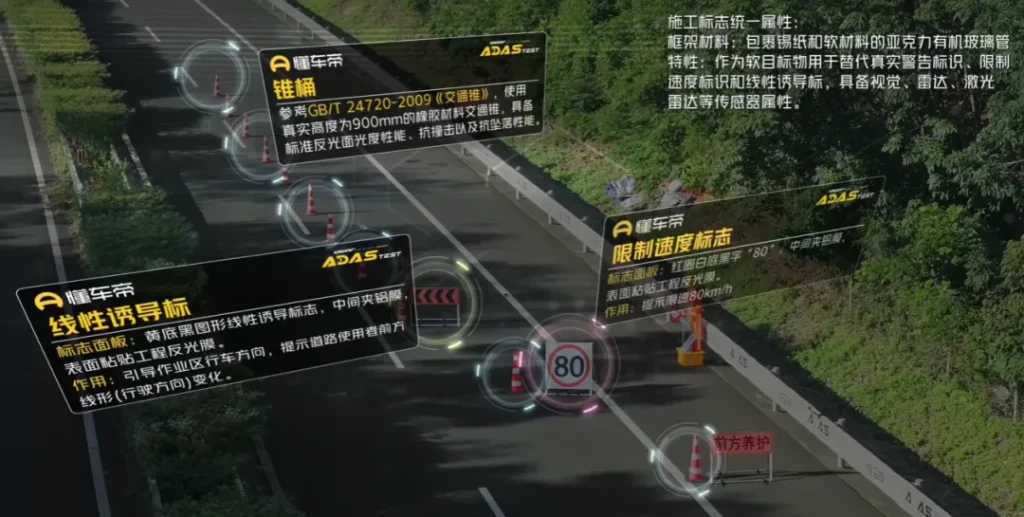
Conclusion: Among 36 vehicles, only 8 could stop before the construction zone, 1 slightly entered the construction area, and the remaining 27 either plowed straight into the construction zone or attempted to collide with left lane vehicles. Pass rate was only 22.22%, still devastating.
| Scenario | Avoidance Method | Collision Avoided | Minor Collision | Severe Collision |
|---|---|---|---|---|
| Highway Temporary Construction | Braking + Avoidance | Tesla Model 3, AITO M7, AITO M9, Avatr 07, Avatr 12, ZHIJIE R7, Denza Z9GT EV, AION RT | AITO M8 | NIO ES6, Han L EV |
| Steering Avoidance | / | / | Tesla Model X, Weipai Blue Mountain, Leopard 5, Zeekr 7X, Zeekr 001, Xingji Yuan ET, Platinum 3X | |
| No Braking/Steering | / | / | Xiaomi SU7, Xiaomi SU7 Ultra, Xpeng P7+, Xpeng G6, Han DM, ICAR V23, Qin L DM, HiPhi, Zeekr C10, Leapao L60, BaoJun PHEV, Zeekr 900, Li L6, Avatr 12, Song Pro DM, Bentchi C-Class, Firefly Lightning Bug, Honda P7 |
Among the 8 passing vehicles, 5 equipped with Huawei intelligent driving products (AITO M7, AITO M9, Avatr 07, Avatr 12, ZHIJIE R7) and Tesla Model 3 first attempted left lane changes for avoidance, but upon finding conditions unsuitable, immediately applied emergency braking and stopped completely before the construction zone. The other 2 vehicles (Denza Z9GT EV, AION RT) decisively began braking upon detecting construction signs, behaving more like human drivers and performing optimally in this round.
Among the failing vehicles, there were still various performance levels. 2 vehicles (NIO ES6, Han L EV) attempted left lane changes for obstacle avoidance but lost emergency braking opportunity when lane change conditions weren’t met, resulting in crashes into the construction zone. 6 vehicles (Model X, WEY Blue Mountain, Leopard 5, Zeekr 7X, Zeekr 001, Xingji Yuan ET, Platinum Zhi 3X) seemed unable to see adjacent lane traffic and insisted on changing lanes left – without driver intervention, they would have collided with adjacent lane vehicles.
The remaining 20 vehicles were even more remarkable, with neither braking nor steering, some without any warning, crashing into construction zones at speeds up to 120km/h. This included the popular Xiaomi SU7, veteran Xpeng G6, and Li L6 with its “refrigerator, TV, and big sofa” setup.
“Entrusting your life to these poor-performing assist driving systems is no different from climbing Everest with crutches.” – Video evaluator’s assessment
03 Construction Zone Truck Encounter
Nighttime, two-lane highway with left lane construction sealed by continuous cones, temporary speed limit signs and construction indicators. A stationary large truck partially intrudes into the right lane, with distance from cones to wheels exceeding 2.5m – theoretically sufficient for all vehicle types to pass. Facing such a complex nighttime construction scenario, human drivers typically choose to slow down and carefully pass the large vehicle. How would vehicles with highway navigation assist respond?
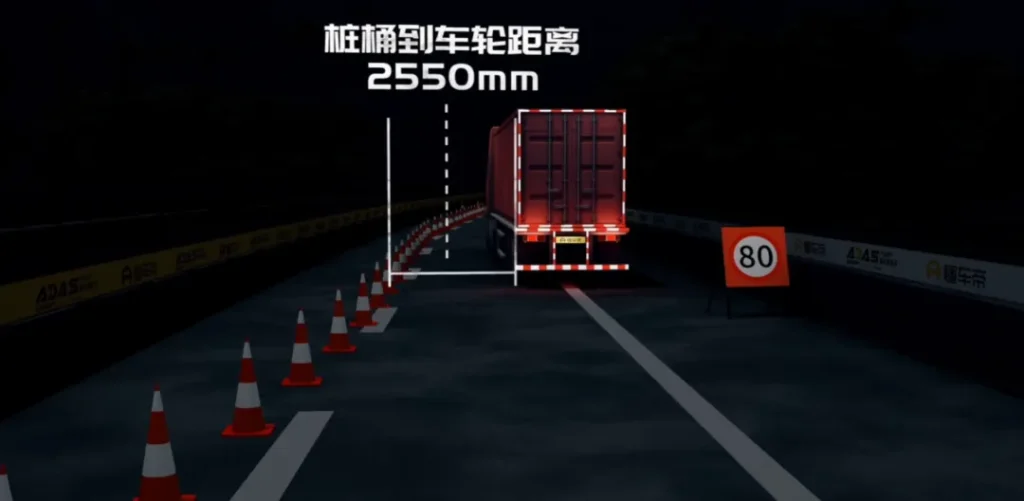
Conclusion: Among 34 participating vehicles, 16 could completely avoid collision, with a pass rate of 47.06%. Compared to the previous two scenarios, this was quite good, but still not optimistic.
| Scenario | Avoidance Method | Collision Avoided | Minor Collision | Severe Collision |
|---|---|---|---|---|
| Construction Zone Truck | Stop | Qin L DM, Xiaomi SU7, Xiaomi SU7 Ultra, Li L6, Denza Z9GT EV, Weipai Blue Mountain, Xpeng G6, AITO M8, ZHIJIE R7, HiPhi, Tesla Model X, Avatr 07, ICAR V23, Platinum 3X | / | Zeekr 900, Zeekr 7X, Zeekr 001, Xingji Yuan ET, Avatr 12, Honda P7, Song Pro DM, Han DM, Han L EV, Xpeng P7+, Firefly Lightning Bug, Leapao L60, Zeekr C10, AION RT, AITO M8, AITO 9, Avatr 12, Leopard 5, BaoJun PHEV |
| Pass Through | Tesla Model 3, AITO M7 | / | / |
Among the 16 passing vehicles, only 2 (Model 3, AITO M7) could automatically pass the truck; the other 14 stopped in front of the truck, leaving it to human handling. This demonstrates that current perception capabilities for lateral distance accuracy of obstacles still have significant room for improvement.
Among the 2 top performers, Tesla Model 3 first applied heavy braking to reduce speed to single digits, then judged it could pass and slowly accelerated past the truck, resembling human driver caution. AITO M7 performed like a divine intervention, slightly reducing speed then passing the truck at approximately 75km/h, with only centimeters between the rearview mirror and truck – truly beyond ordinary driver capabilities, like a deity descending to earth.
The poor performers each showed their incompetence differently – some drove straight into trucks, others headed into construction zones without looking back, quite lamentable.
04 Highway Accident Vehicle Surprise
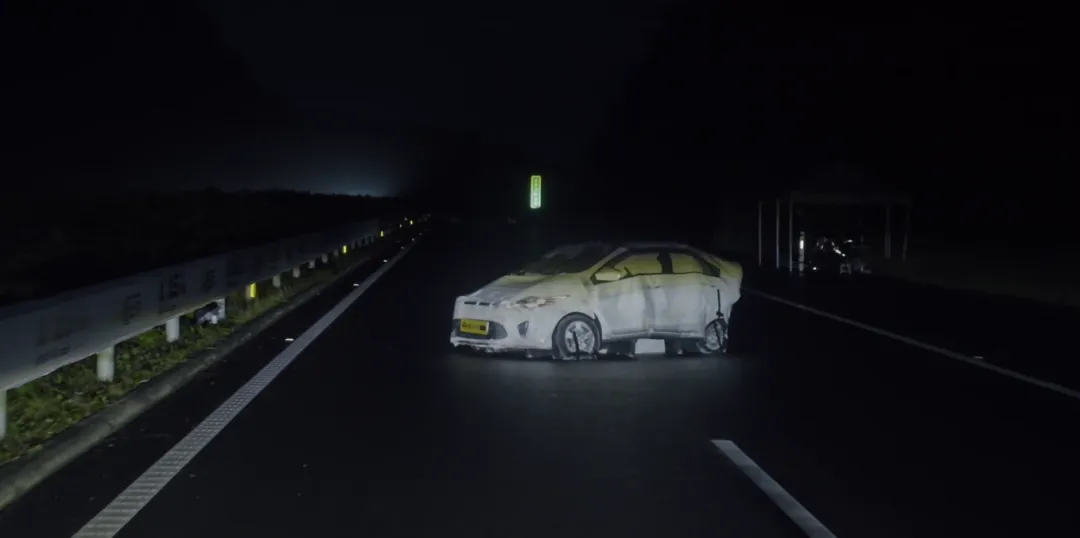
Two-lane highway with an out-of-control “ghost car” diagonally positioned in the road center, 2.4 meters from the road edge. Human drivers typically choose to slow down and carefully pass. How would vehicles with highway navigation assist respond?
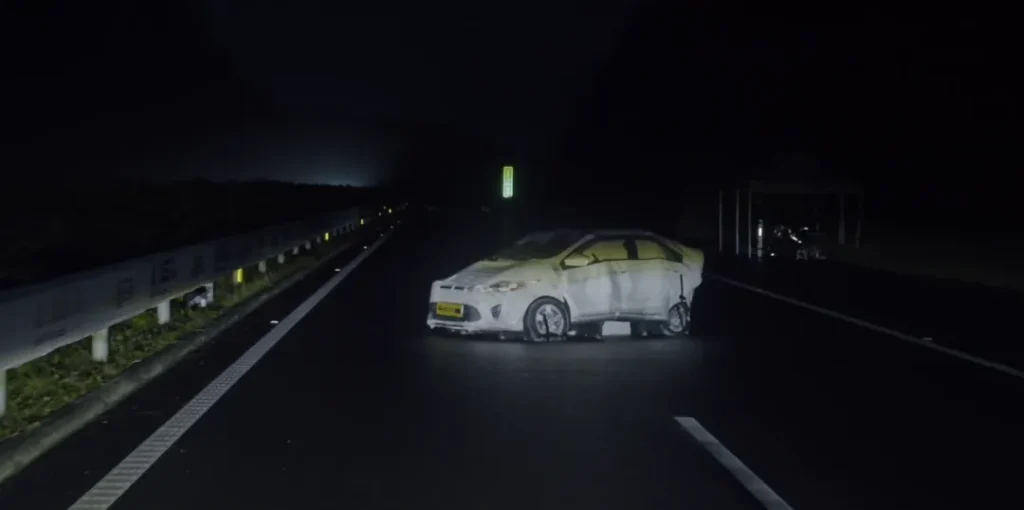
Conclusion: Among 34 test vehicles, 10 could completely avoid collision, with a pass rate of 29.41%. Compared to previous tests, this was moderate performance.
| Scenario | Avoidance Method | Collision Avoided | Minor Collision | Severe Collision |
|---|---|---|---|---|
| Highway Accident Vehicle | Braking + Avoidance | AITO M9, Avatr 12, Leopard 5, ZHIJIE R7, Xpeng G6, Tesla Model 3, Tesla Model X, Platinum 3X, Weipai Blue Mountain, AION RT | Han DM, Zeekr 7X, Xpeng P7+, Zeekr 001 | Li L6, Zeekr 900, Xingji Yuan ET, Avatr 12, Honda P7, Song Pro DM, Han L EV, Firefly Lightning Bug, Leapao L60, Zeekr C10, BaoJun PHEV, Qin L DM, Xiaomi SU7, Xiaomi SU7 Ultra, HiPhi, Tesla Model X, ICAR V23, Denza Z9GT |
| Bypass Avoidance | / | AITO M8 | AITO M7, Avatr 07 |
The 10 passing vehicles all stopped before the accident vehicle by activating emergency braking. Among 5 vehicles with minor collisions, 4 had slightly late braking timing causing minor impacts, while AITO M8 was overconfident, believing remaining width was sufficient for passage, resulting in minor scraping with the accident vehicle.
Among remaining failures, 2 vehicles with Huawei intelligent driving (AITO M7, Avatr 07) showed blind confidence and blind avoidance, causing serious collisions during bypass attempts. Other vehicles either detected the accident vehicle late, triggered emergency braking too late, or showed complete indifference.
05 Aggressive Highway Entrance Cutting
Everyone driving on highways through complex entrances and exits has likely encountered vehicles that ignore ethics and traffic rules, suddenly cutting across three lanes – extremely rogue behavior that unfortunately exists. Human drivers typically slow down and wait for the offending vehicle to clear before resuming normal driving. How would vehicles with highway navigation assist respond?

This scenario was a bonus test, only for vehicles surviving daytime accident scenarios and showing highlights in nighttime performance.
Conclusion: Among 21 test vehicles, only 4 could completely avoid collision, with a pass rate of 19.05%.
| Scenario | Avoidance Method | Collision Avoided | Minor Collision | Severe Collision |
|---|---|---|---|---|
| Highway Entrance Aggressive Cutting | Braking + Avoidance | AITO M9, Tesla Model X, Tesla Model 3, Denza Z9GT | AITO M7, Li L6, ZHIJIE R7, Avatr 07 | Xpeng G6, Platinum 3X, BaoJun PHEV, Bentchi C-Class, Xiaomi SU7, Avatr 12, AION RT, AITO M8, NIO ES6, Zeekr 900, Han L EV, Zeekr 001, Weipai Blue Mountain |
This scenario’s difficulty lay in recognizing cutting-in intention and speed. Passing vehicles could identify cutting-in intention early and plan deceleration avoidance in advance, while failing vehicles only saw danger at the last moment, showing no predictive capability. After detection, some manufacturers chose to “pass the buck” to humans 1 second before collision – truly “sitting in the car while blame falls from the sky.”
“On empty highways, they’re harmless little white mice, but as soon as accident scenarios become complex, they immediately throw in the towel.” – Video evaluator’s assessment
06 Reckless Crossing Wild Boar
Large animals, while uncommon on highways, represent real scenarios. Imagine driving with assist driving activated, comfortably cruising on the highway, listening to music and singing, everything seeming relaxed. Suddenly, a wild boar appears crossing the highway. Collision could result in vehicle damage at minimum, or injury from the boar at worst. Human drivers facing this scenario basically adopt significant deceleration for avoidance. How would current assist driving systems choose?

Each brand selected their best-performing vehicle from previous tests, totaling 22 vehicles participating. Heartbreakingly, only 1 vehicle could avoid collision with the wild boar.
Conclusion: Pass rate was only 4.55%.
| Scenario | Avoidance Method | Collision Avoided | Minor Collision | Severe Collision |
|---|---|---|---|---|
| Wild Boar Crossing | Braking + Steering | Tesla Model X | / | AITO M9, NIO ES6, Tesla Model 3, Platinum 3X, Denza Z9GT |
| Light Deceleration | / | / | Li L6, Zeekr 900, Qin L DM, AION RT, ICAR V23, ZHIJIE R7, Weipai Blue Mountain, Avatr 12, Honda P7, Xpeng G6, Avatr 12, Xiaomi SU7, Zeekr 001, Zeekr C10, Bentchi C-Class | |
| No Recognition | / | / | [Multiple vehicle models listed in red section] |
The sole lucky winner was Tesla Model X, which through braking and in-lane maneuvering, let the wild boar cross first before proceeding.
The remaining 21 vehicles all had serious collisions with the wild boar – they could all luckily take the boar home for dinner. The difference was that 5 vehicles could recognize the wild boar and took warning or light braking actions to alert drivers, without full braking. The remaining 16 vehicles couldn’t even detect it, all making “intimate contact” with the wild boar at speeds exceeding 120km/h. Those presentation PPTs claiming ability to recognize irregular obstacles apparently remain in PPT form.
Unexpectedly, the wild boar became the biggest mountain facing assist driving systems. Such corner cases or long-tail problems are numerous, requiring serious consideration of solutions rather than chasing end-to-end, VLM/VLA trends. What use are cutting-edge models when a wild boar exposes your true nature?
07 Summary
Finally, we can present that widely circulated image on social media. Controversies about this image continue – we’ll discuss these controversies in our next article. Let the bullets fly for a while.
Source:https://mp.weixin.qq.com/s?__biz=MzI2NDY3OTExNw==&mid=2247491663&idx=1