

China’s Auto Market Consolidation: From Fragmentation to Concentration
The top 10 automakers in China have steadily increased their market share in recent years, yet concentration remains lower than in mature markets. Against a backdrop of slowing growth and intensifying competition, market consolidation and industry shakeout will dominate the sector for years to come.
The Shift to a “Survival-of-the-Fittest” Era
China’s auto industry has transitioned from rapid expansion to an era of stock competition. As BYD Chairman Wang Chuanfu predicted in 2022: “2023 will mark the start of the elimination race in China’s auto industry.” Over the past two years:
- Established brands vie for greater market dominance.
- Surviving newcomers fight to secure their foothold.
Rising Market Concentration (CRN)
Industry Concentration Rate (CRN) measures the combined market share of a market’s N largest players. As weak players exit and leaders consolidate:
- Markets shift from fragmented to concentrated.
- CRN rises accordingly.
Data Spotlight: CR Trends (2023–2025)
Based on retail sales data from CPCA (China Passenger Car Association):
- CR10 (Top 10 players):
- 2023: 59% → 2025: ~65%
- CR3 (Top 3 players):
- 2023: 27% → 2025: 35%
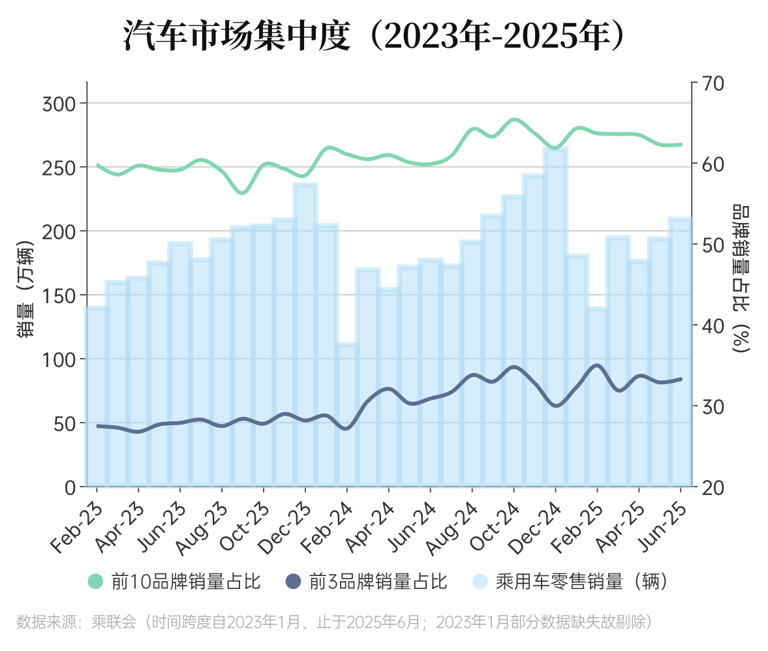
This upward trajectory aligns with increasing competition in the new energy vehicle (NEV) era.
Market Reshuffle: Winners, Losers & New Entrants
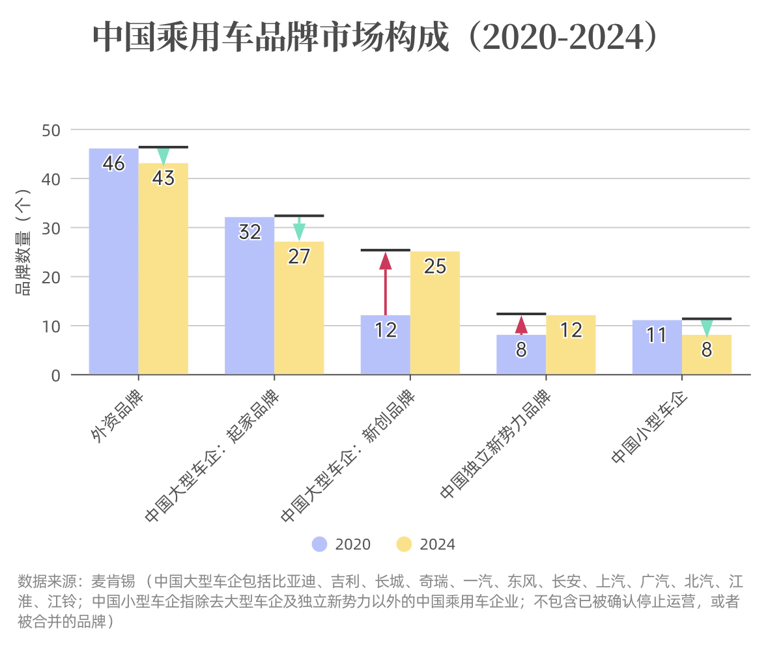
McKinsey notes China’s auto “qualifying round” ended in 2019, followed by an elimination phase:
- Dominant brands (600k+ annual sales):
- 2020: 11 brands → 2024: 13 brands
- Mid-tier brands (240k–600k sales):
- 2020: 7 brands → 2024: 10 brands
- 9 are Chinese automakers; only 1 foreign
Key Shifts:
- Exits: Foreign brands retreated.
- New entrants: ⅔ of active EV brands are spin-offs from legacy automakers; only 12 are independent startups.
NEVs: Higher Concentration but Unstable Hierarchy
While NEV market concentration (CR3≈50%; CR10≈80%) exceeds the broader auto market, its competitive landscape remains volatile. Analysts attribute this to:
- Multi-brand strategies: Top players split sales across subsidiaries, diluting apparent concentration.
- Rapid small-brand growth: Gains and losses among smaller NEV makers offset consolidation.
NEV Leaderboard:
BYD dominates with 28.9% share—greater than the combined share of #2–#5 players. Its success stems from:
- Product diversity + aggressive pricing
- Mass-market brand recognition
Why Fragmentation Hurts: Goldman Sachs’ Warning
Despite consolidation, China’s market remains structurally fragmented:
- Top 10 players’ share: <80% (vs. >90% in developed markets).
- Active automakers: 49 (vs. ~30 in mature markets).
Risks of Fragmentation:
- ❌ Hinders industry-wide price coordination.
- ❌ Prevents efficient capacity adjustment.
- ⚠️ Widens cost gaps between top and lower-tier players → squeezes marginal players’ survival space.
The Consolidation Endgame: Oligopoly & Price Wars
As markets mature, a handful of giants typically emerge, wielding overwhelming scale, resources, and pricing power. During consolidation:
- Price wars erupt, often ignited by cost leaders.
- Wars end only when oligopolistic stability is achieved.
China’s Price War Truce?
After years of cutthroat discounts, regulators stepped in:
- Late June 2024: MIIT (Ministry of Industry and IT) and four ministries issued Guidelines on Regulating Auto Industry Competition, demanding:
- An end to “irrational promotions.”
- Price fluctuation monitoring.
- July 2024: BYD, Changan, BAIC BluePark canceled interest subsidies, retaining only state-backed “trade-in” incentives.
Outlook: Scale + Tech = Survival
Morgan Stanley forecasts:
- 2025 sales growth: 3% (to 28.3M units including exports).
- NEV penetration growth slows post-2026.
2025 is pivotal: Transition from volume growth to value restructuring.
- CR10 could reach 75% in 2–3 years (up from 65% in 2023).
- Ultimate survivors: Players with scale advantages + unassailable tech barriers.
The race isn’t just about speed—it’s about stamina and strategy.