

520-Line LiDAR Hits Production: The New L3 Benchmark
This year, Level 3 (L3) autonomous driving has surged into the spotlight. At its core, L3 is about liability coverage: when L3 systems fail, automakers bear responsibility.
Compared to L2 driver assistance, this demands significantly stronger perception capabilities, computing power, and algorithms. While software advancements and regulatory frameworks take time to mature, the hardware arms race for L3 has quietly begun.
The L3 Arms Race Ignites in the Ultra-Luxury Segment
In the ultra-luxury market, technological foresight is essential to match the brand’s status and win customer aspiration and trust. L3 capabilities and generation-leading hardware have become the ideal solution for ultra-luxury brands to achieve this technological edge.
For instance, the ultra-luxury SUV Zeekr 9X recently held a technology launch, officially announcing its L3-capable intelligent driving solution—the “Qianli Haohan H9 System”—boasting “eightfold full-link redundancy” across chips, perception hardware, algorithms, steering, braking, and communication. The most iconic component is the industry’s first mass-produced RoboSense 520-line ultra-high-resolution LiDAR.


Under L3 rules, safety redundancy becomes tangible through specific components. As Geely Group’s luxury flagship for the next era, Zeekr 9X co-developed and mass-produced the world’s first 520-line digital LiDAR with RoboSense. Meanwhile, Huawei’s Harmony Intelligence Driving L3 system adopts a dual approach of perception architecture and redundancy configuration. The ultra-luxury executive sedan Zunjie S800 features 4 LiDARs, a triple-distributed 4D millimeter-wave radar array, and 11 cameras to ensure stable and reliable performance.
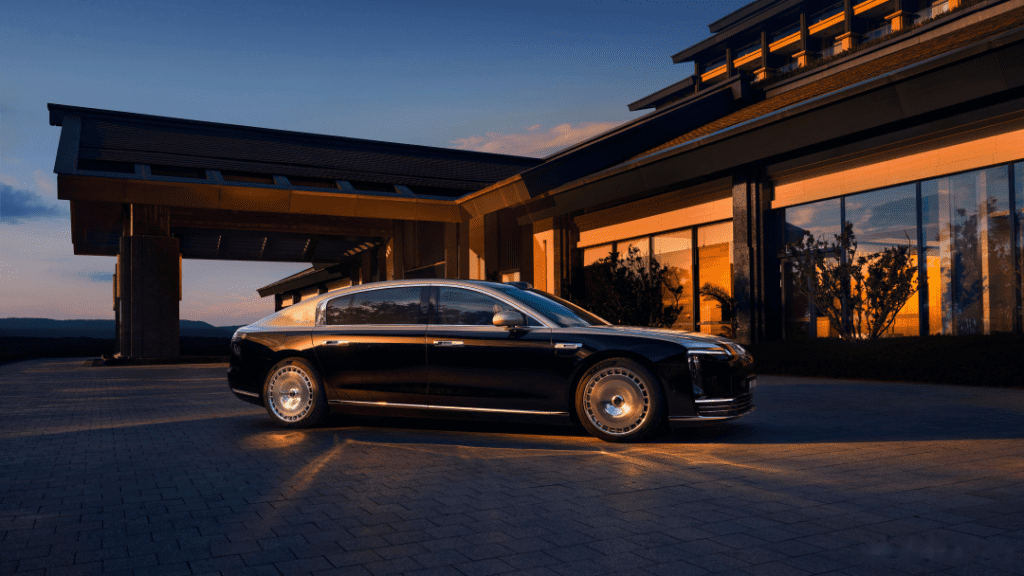
Not long ago, Voyah also unveiled its L3 intelligent architecture—”Tianyuan Smart Chassis”—co-developed with Huawei, utilizing LiDAR with over 700 lines. The first ultra-luxury model equipped with this system will launch within the year. As multiple products reach mass production, we may be entering a new era of ultra-high-line-count LiDAR.
「520 Lines」: The New Standard for L3 Autonomous Driving
The significance of this LiDAR extends far beyond mere “parameter enhancement.”
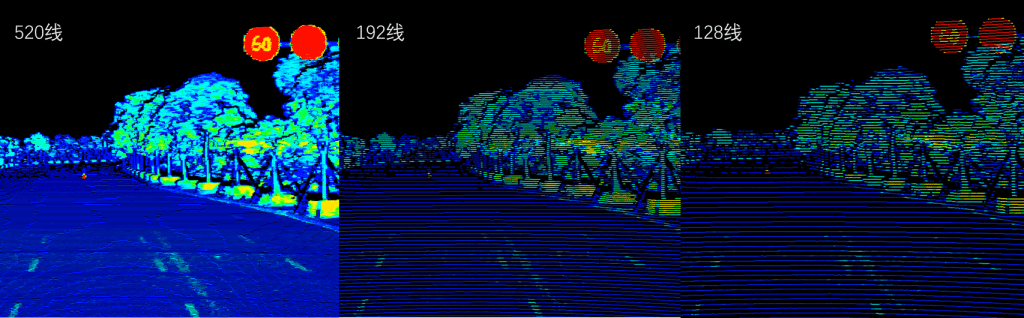
520 lines represent not just numerical leadership but a substantial leap forward for the entire L3 perception system. It’s currently the highest line-count mass-produced automotive-grade LiDAR, with nearly 3 times the vertical resolution of the previous highest (192 lines). It generates denser point cloud data, achieves 300-meter long-range detection, accurately identifies obstacles as small as 75cm, and maintains centimeter-level positioning stability in adverse conditions like rain and fog.
Compared to other mainstream products, it’s not just incrementally better—it operates on a fundamentally higher level.

This LiDAR doesn’t just push line-count to the ceiling; it achieves full-process digital processing. Core capabilities like its digital architecture, crosstalk elimination, full-condition electrical signal processing, and lossless data compression ensure its perception data offers higher engineering usability and system integration efficiency.
This means it’s no longer an “optional” high-end sensor but a critical safety component within the L3 system. For the first time, LiDAR has been pulled into the core liability chain, becoming an integral part of the system’s closed loop.
L3 is the dividing line. Below it, LiDAR is about enhancing experience; above it, LiDAR is about liability—the technical foundation for compliance and responsibility demarcation.
Therefore, while LiDAR might have been a “nice-to-have” in the past, it’s now an essential safety component, with 500+ line products becoming the baseline requirement for system liability coverage.
Redefining “Technological Luxury”
For many luxury car owners today, intelligence isn’t about spectacle—it’s about peace of mind.
The “effortless ease” luxury users seek fundamentally relies on the system covering the lower limit of human attention. This can’t be provided by materials, scents, or ambient lighting. Its prerequisite is a system possessing comprehensive risk identification and handling capabilities: the ability to perceive environmental details, anticipate dangers, execute stable takeovers, and bear the consequences of critical misjudgments. LiDAR is the starting point of this closed loop.
Especially 500+ line digital LiDAR: it doesn’t just boost specs; it provides stronger guarantees at the perception level. Accurately identifying a 75cm obstacle at 300 meters isn’t just about seeing farther—it’s about whether the system can intervene one crucial step earlier.

In Conclusion
Redefining luxury, therefore, is really about rewriting the logic of responsibility allocation.
Who judges? Who anticipates? Who takes over? Who covers the liability? In an L3 architecture, these questions cannot be ambiguous, error-tolerant, or compensated by a driver “standing by.” When Mercedes-Benz dares to take responsibility for L3 accidents, it’s because it has raised the system’s baseline to the starting point of liability. When BYD signs a “safety liability pledge” for parking, it relies on the stability of the system’s closed loop—only by making judgments for the user can it bear the consequences for the user.
Within this framework, LiDAR must be the component that first sees the truth, first sounds the alarm, and first initiates action.
Ultimately, the next luxury competition isn’t about leather, screens, or gadgets—it’s about who dares to say first: “I am responsible for this system.” And it seems ultra-high-line-count LiDAR may fire the starting shot in this race.