
World’s First Positive Unit Economics for L4 Trucks in Ordos
Recently, Mark Zuckerberg, the founder of FACEBOOK, has been aggressively poaching talent in Silicon Valley, offering salaries in the “hundreds of millions of dollars” to lure core AI talent from companies like OpenAI and Apple. Meanwhile, roughly 10,000 kilometers away from Silicon Valley in Ordos, China – a place seemingly disconnected from AI – a group of AI engineers who returned from Silicon Valley are frequently seen. Had they stayed in Silicon Valley, they too could likely command massive salaries. So, what are they doing in China, in Ordos?
The answer: They have successfully commercialized a crucial application of AI – autonomous driving for trucks – and are sprinting towards profitability. They are the executives of autonomous trucking company KargoBot, including CEO Wei Junqing, VP of Planning & Control Algorithm R&D Wang Qian, and VP of AI R&D Wang Ke…
In mid-August, Wei Junqing announced at a media event in Ordos that KargoBot is the first in the L4 autonomous driving race to achieve a positive single-vehicle economic model and a virtuous cycle. Furthermore, KargoBot COO Li Xiaoxiao stated that within a few years, once KargoBot’s fleet reaches 1,500 to 2,000 trucks, the company will achieve profitability.
01 Single-Vehicle Economics Turn Positive
Current autonomous driving projects, regardless of the scenario, face two challenges: small scale (mostly in demonstration or early commercial operation phases) and operating at a loss. KargoBot, however, is different. Although the team hails from Silicon Valley, they place high importance on feasibility, necessity, scale, and operations.
“Over the past two-plus years, we have consistently operated the world’s largest autonomous truck fleet, and we have achieved true L4 unmanned commercial operation,” said Wei Junqing.
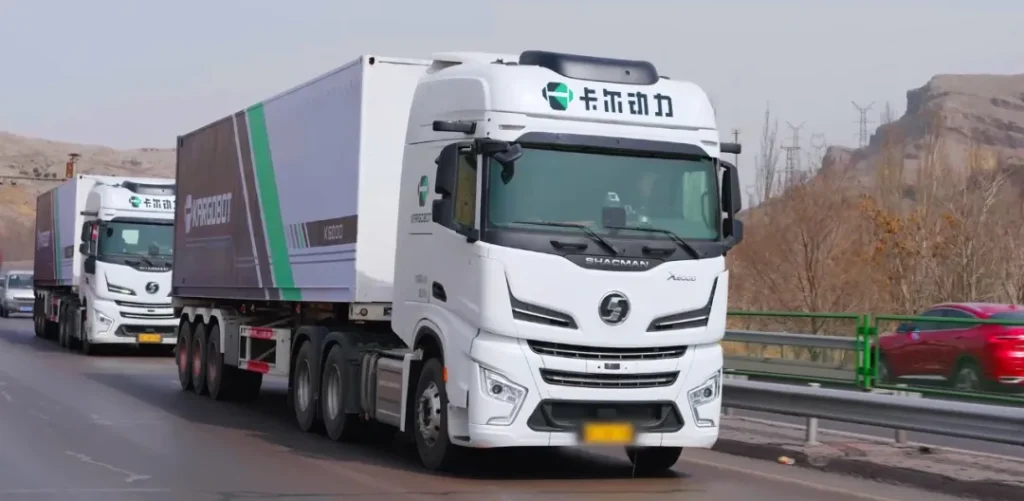
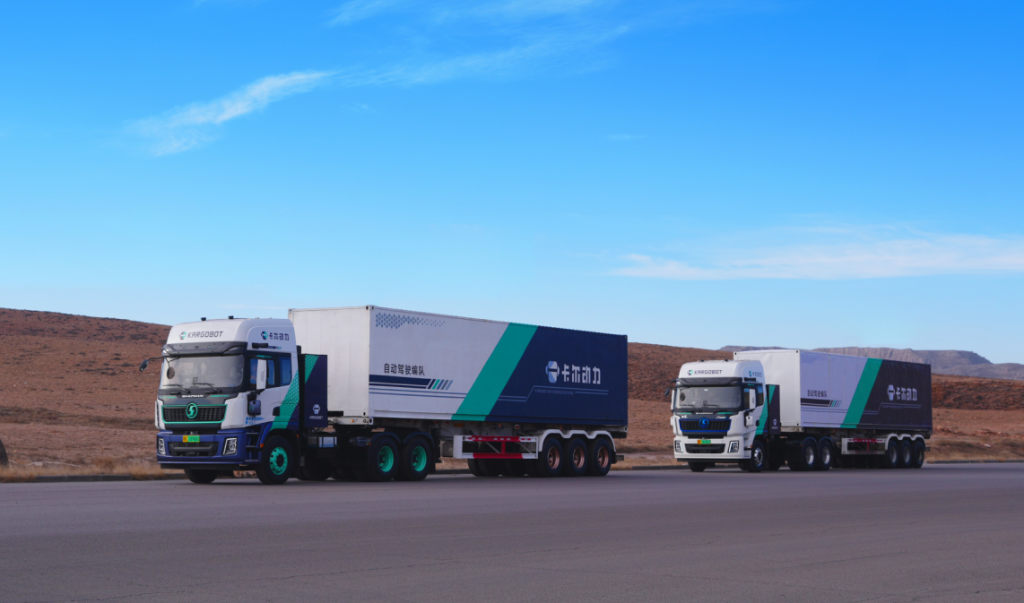
Wei introduced that in 2021, DiDi’s autonomous driving division decided to focus on autonomous trucks, incubating KargoBot. After identifying Ordos as an ideal freight truck deployment scenario, KargoBot first experimented with single-vehicle autonomy before pioneering a “mixed platoon mode” (human-driven trucks + autonomous trucks platooning).
After more than four years of refinement, Wei presented the results, summarized with four characters: “An, Wen, Sheng, Li” (Safe, Stable, Saving, Profitable).
- An (Safe): KargoBot’s autonomous trucks are currently over 5 times safer than human drivers. “But we believe this is far from enough. Our data accumulation and R&D will increase this multiple by 2-3 times annually – 5x now, 10x next year, 30x the year after,” Wei stated.
- Wen (Stable): The trucks feature triple-redundant braking systems and dual-redundant steering, eliminating single-point failures that could compromise stability.
- Sheng (Saving): KargoBot can reduce driver costs by up to 83% through autonomy.
- Li (Profitable): Refers to economic benefits. “Not only does KargoBot benefit, but logistics providers, factories, etc., all gain optimal benefits, creating a positive cycle.”
Wei emphasized the “Li” aspect: “Over the past two months, we have stably pioneered L4 unmanned commercialization in the trillion-dollar truck freight market. Our vehicles are firstly unmanned, secondly hauling bulk cargo, and thirdly genuinely charging customers. We’ve achieved China’s first fully unmanned platoon operation.” He added, “We’ve validated that the gross profit per vehicle can be 3-6 times higher than manned vehicles on different routes… saving nearly 200,000 RMB per vehicle annually in labor costs.”
While single-vehicle gross profit is crucial, Wei outlined future projections. In the traditional trucking model, out of 100% revenue:
- Energy costs: ~1/3
- Driver & labor costs: ~1/3
- Other (tolls, maintenance, depreciation, etc.): The remainder
- Gross Margin: ~4%
KargoBot’s initial “one-drags-one” platoon model (1 human-driven + 1 autonomous truck) saves 50% of driver costs, adds ~100,000 RMB in equipment costs, and achieves gross margins over 3 times the traditional model. Long-term, using purpose-built “transport robots” (removing cabins, lowering manufacturing costs and weight, increasing cargo capacity, enabling more efficient transport) could push margins to 6 times traditional levels.
Regarding scaling the current “one-drags-one” model, Li Xiaoxiao stated: “We’ve achieved the 0 to 1 milestone of positive single-vehicle Unit Economics (UE). The next step (1 to 10) is achieving positive UE per vehicle and per route on multiple routes. From 10 to 100 involves deploying 100-200 trucks per route on these routes, reaching a total fleet size of 1,500-2,000 trucks, achieving company-level profitability.”
02 Balancing Commerce and Technology
Autonomous driving is fundamentally technology-driven. KargoBot’s commercial exploration is built on its autonomous tech. Pragmatically, they didn’t start with single-truck autonomy but chose the “mixed platoon mode” – a human-driven truck leads, followed by autonomous trucks, up to “one-drags-five“. This decision, made after extensive on-road testing in Ordos by Wei and others, led KargoBot to develop its L4 system specifically for intelligent platooning.
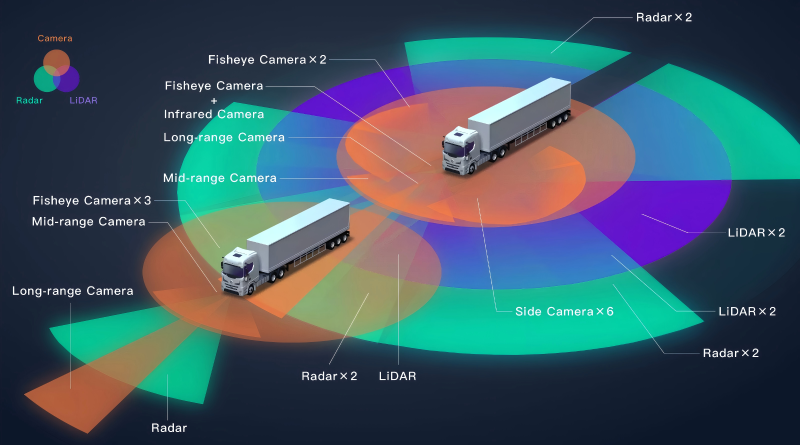
Perception: In a platoon, not only do the following L4 trucks need perception, but the lead truck also has L2 sensors to overcome occlusion for the followers. Lead truck data is shared with followers via V2V communication with <100ms latency, effectively extending perception range and enabling earlier decision-making.
Localization: Using positioning devices across the platoon, KargoBot achieves highly accurate localization even in multi-kilometer GPS-denied tunnels.
Decision & Control: The lead truck’s trajectory and actions (e.g., throttle, brake signals) are transmitted via V2X. Following trucks can use the lead driver’s behavior as a reference. “However, the following trucks possess full L4 capability, so they can autonomously avoid any potential risks detected during this process,” explained Wang Qian, VP of Planning & Control Algorithm R&D. This capability enables precise maneuvers like autonomously driving onto weighbridges.
KargoBot actively adopts cutting-edge tech like end-to-end (E2E) models. “2024 is the first year of scaled E2E production. In August 2024, we proposed an L4 autonomous platoon solution also utilizing E2E technology,” Wang Qian stated.
KargoBot’s E2E architecture isn’t extreme:
- It incorporates Vision-Language Models (VLM).
- It’s a two-stage E2E model (Perception & Prediction / Planning & Control).
- A “behavior selector” acts as a safety net, making final decisions rather than letting the system “fly free”.
“Precisely because of this E2E solution and our intelligent platooning tech, our platoon’s takeover metrics are now over 10 times better than L4 single vehicles,” Wang Qian added.
KargoBot isn’t stopping at mixed platooning + E2E. Wang Ke, VP of AI R&D, explained that previous autonomous development relied solely on imitation learning, which can approach human driver levels but struggles to surpass them. “We aim to break through data limitations using reinforcement learning (RL) to achieve better performance.”
KargoBot developed a six-stage data training method:
- Train on internet/open-source foundation models.
- Utilize rich data pools (human-driven/autonomous/social vehicles/cars), e.g., DiDi ride-hailing & Robotaxi data.
- Build a foundation model using KargoBot’s own data (trucks/single-vehicle/social vehicles).
- Fine-tune for application scenarios.
- Perform open-loop, closed-loop, and RL training tasks.
In the RL stage, KargoBot developed its own world model, achieving performance twice that of the leading academic OCC model. Wang Ke also revealed that KargoBot plans to open-source this world model.
“Whether it’s E2E, VLA, mapless, or BEV, we have solid technical reserves and a strong technical advantage in the trucking domain. But ultimately… the technology that realizes commercial value is the ‘good cat‘,” Wang Ke concluded on technical debates.
03 Trillion-Dollar Market
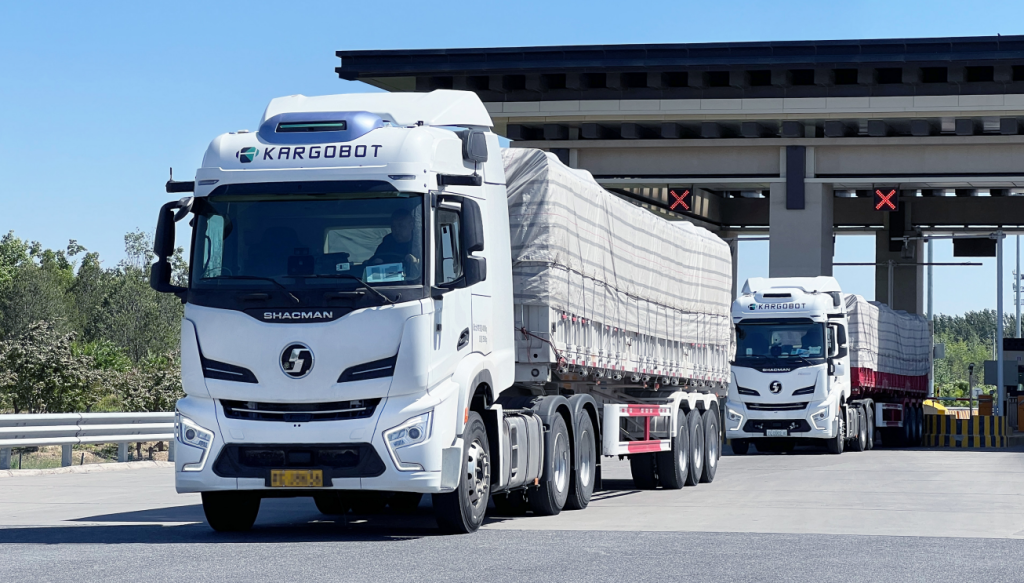
Ordos has proven a boon for autonomous trucking. Li Xiaoxiao noted that Ordos City has 300,000 heavy trucks and offers a favorable policy environment. KargoBot was selected as the only L4 autonomous truck project in the Ministry of Transport’s second batch of Intelligent Transport Pioneer Application Demonstrations there. After receiving unmanned commercial pilot permits in May, KargoBot now achieves 5,000 km daily of autonomous platoon operation and 200 km daily of unmanned freight safety testing in Ordos. Features like autonomous toll booth passage are operational.
KargoBot also operates elsewhere, serving 20 clients across 10 provinces/municipalities with a fleet of 300 unmanned autonomous trucks.
For future expansion, Wei Junqing outlined a “1+N+X” strategy:
- 1: Deeply penetrate the Otog Banner area in Ordos (current base), aiming to operate over 1,000 unmanned vehicles there and expand throughout Inner Mongolia.
- N: Expand to regions with logistics links to Ordos (Xinjiang, Shaanxi) and explore key points (Sichuan, Guangxi, Beijing-Tianjin-Hebei) to gradually build a national network.
- X: Diversify industries – starting with coal, expanding to steel, electronics, agriculture/animal husbandry, feed/crops, and express freight. “We will achieve regional and industrial generalization along the entire bulk energy supply chain.”
“In the autonomous driving industry, the survivors or ultimate winners aren’t those who start first, but those who reach the toll booth the fastest,” Wei Junqing asserted. He emphasized that autonomous freight is the only trillion-dollar market for autonomy and the most realistic path for L4 deployment. “We believe this sector will inevitably produce one or even multiple Global Fortune 500 companies that capture significant commercial value from this trillion-dollar market.”