
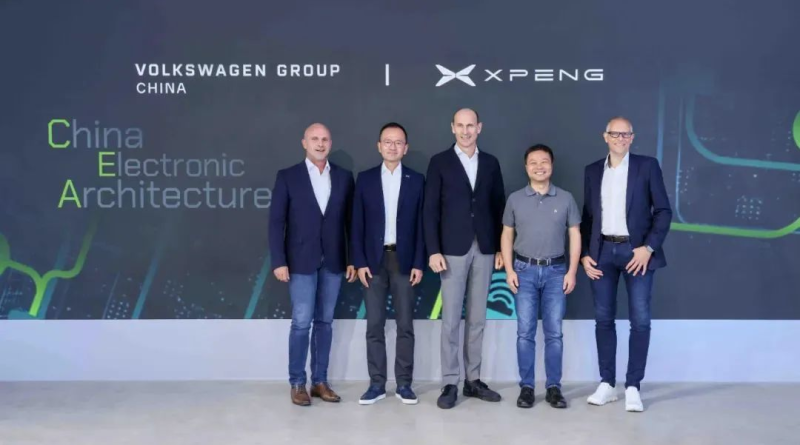
Xiaopeng, VW Expand Tie-up: China EV Tech to Retrofit ICE Cars
August 15 — Xiaopeng Motors and Volkswagen Group jointly announced an expanded strategic cooperation agreement on Electronic and Electrical Architecture (EEA) technology. This marks the first time their co-developed EEA will be deployed beyond pure electric vehicles, extending to Volkswagen’s fuel-powered and plug-in hybrid platforms in China.
Ending “EV-Exclusive Intelligence”
Under the agreement, all Volkswagen fuel vehicles sold in China will adopt the jointly developed China EEA (CEA) architecture from 2027 onward, shattering the traditional notion that “intelligence is exclusive to EVs.” This collaboration represents the first instance of a Chinese EV startup acting as a technology provider, deeply penetrating the core domain of traditional ICE vehicles. It signals China’s historic shift from “exchanging market access for technology” to “trading technology for market share.”
Breakthrough: Unified Intelligence for EV and ICE
The centerpiece of this partnership is the CEA architecture. Featuring a centralized design, it consolidates dispersed ICE control units into three domain controllers, reducing wiring harness length by 40% and vehicle weight by 15 kg. Crucially, this architecture—derived from Xiaopeng’s EEA 3.0—injects “smart genes” into ICE vehicles:
- Engine control software supports OTA remote upgrades
- Transmission logic dynamically optimizes based on driving habits
- AI assistant enables dialect recognition and emotional interaction
- Future OTA updates to enable urban NOA autonomous driving
Volkswagen’s compromises carry symbolic weight. When the German giant acquired a 4.99% stake in Xiaopeng for $700 million in July 2023, it was mockingly dubbed a “poverty-alleviation-style investment.” Yet cooperation deepened rapidly: from joint procurement for cost reduction to co-developing CEA for EVs, and now retrofitting ICE vehicles with Chinese technology. Behind this shift lies traditional automakers’ collective anxiety—balancing ICE cash flows while racing to close the intelligence gap.
China’s Tech Export Ecosystem Emerges
Xiaopeng-Volkswagen isn’t an isolated case:
- Leapmotor licensed its LEAP 3.0 Clover architecture to Stellantis
- Audi adopted SAIC’s pure EV platform for new models
- Toyota Camry integrated Huawei’s smart cockpit system
- Honda’s “Ye” brand emphasizes China-led R&D
Data underscores this disruptive shift:
China’s 2023 EV output/sales: 9.587 million units (>60% global share)
CATL’s global battery market share: 37%
BYD’s integrated e-drive efficiency: 92%
Xiaopeng XNGP achieved nationwide map-free autonomy
Nankai University’s solid-state battery prototype: 400Wh/kg (enabling 1,000 km range)
This technological prowess stems from three breakthroughs:
- Batteries: World’s largest supply chain ecosystem
- E-Drive: BYD’s lightweight integrated 8-in-1 solution
- Smart Tech: Full-stack R&D from chips to algorithms (Xiaopeng/Huawei)
As Germany’s Automobilwoche noted: “The inventor of the automobile is buying Chinese licenses.”
Redefining Global Standards
Volkswagen’s pivot is strategic: its 2024 ICE market share in China hit 21% (highest since 2005), yet EV penetration exceeded 42%. Facing inadequate charging infrastructure in lower-tier cities, VW chose “technological democratization” to extend ICE lifecycle. The new Tayron L’s IQ.Pilot system uses “hardware redundancy + software layering” to achieve L2+ autonomy—a cost-effective innovation buying time for electrification.
When Xiaopeng’s tech blankets VW’s ICE platforms by 2027, and Leapmotor’s architecture powers Stellantis’ premium brands, China’s automotive technology transcends geographical boundaries. This isn’t mere licensing—it’s deep collaboration encompassing joint development, localization, and ecosystem co-creation. As Volkswagen Group China CEO Ralf Brandstätter stated:
“Our cooperation with Xiaopeng isn’t an endpoint—it’s the starting line for redefining global automotive standards.”
Epilogue
From China’s 9-year reign as the world’s largest EV producer to its dominance in batteries, e-drive, and autonomous driving, the balance of power in global automotive has irrevocably tilted. This transformation transcends technology—it heralds the rewriting of industrial rules. The future of automotive standards may well be defined by those who were once followers.