
Overseas Tier 1 Bosch’s End-to-End Assisted Driving Technology is Coming!
The autonomous driving technology sector is currently facing a critical crossroads in terms of technological pathways.
On one hand, large model solutions represented by VLA (Vision-Language-Action) have garnered widespread attention, representing the possibility of highly intelligent future capabilities.
On the other hand, “single-stage end-to-end” architecture has become the current mainstream technological pathway due to its engineering advantages and implementation efficiency.
In the VLA solution route, companies like Li Auto, XPeng Motors, and DeepRoute.ai are actively making strategic moves. Li Auto’s first pure electric SUV was delivered in late August, with VLA technology simultaneously deployed.
It should be noted that although VLA has a high capability ceiling and can be viewed as the next development direction for assisted driving, such technology creates significant implementation pressure for OEMs and poses major challenges for engineering capabilities.
Regarding this, Wu Yongqiao, President of Bosch Smart Mobility China, mentioned at the WAIC conference held in July this year that although VLA has long-term potential, it still faces multi-dimensional challenges in areas such as multimodal feature alignment, data training complexity, and chip computing power, making mass production deployment difficult to achieve in the short term.
From an engineering progress perspective, Bosch persists in advancing the “single-stage end-to-end” solution and has already partnered with WeRide to create a mass production solution with highly humanized driving experience based on the Orin-Y chip, which officially landed on Chery’s high-end models this year.
From this perspective, compared to VLA technology, single-stage end-to-end currently has more practical significance.
From a mass production standpoint, Bosch’s assisted driving can achieve “lightning-speed implementation” – on one hand by choosing the right “path,” and on the other hand, it’s inseparable from its mass production capabilities.
01. VLA Implementation Still Has Distance to Go – Computing Power Gap Exists
According to data from the China Passenger Car Association (CPCA), from January to April 2025, the installation rate of L2 and above assisted driving functions in new energy passenger vehicles reached 77.8%.
Behind the continuously rising installation rate of assisted driving, how to choose the technical route is also a key factor, directly affecting the speed of new technology deployment.
Currently, the industry mainly has two technical routes: end-to-end large models and VLA large models.
Among these, end-to-end large models simplify system complexity and improve generalization capabilities by integrating perception, decision-making, planning, and control into a single model.
VLA large models go further by combining vision, language, and action, endowing the system with more powerful reasoning capabilities and scenario understanding abilities, viewed as the next-generation technology direction for intelligent driving.
Bosch proposes that VLA technology still faces three major technical bottlenecks in the short term.
First is the difficulty in multimodal feature alignment. Feature alignment between vision, language, and action faces technical bottlenecks, requiring solutions to cross-modal semantic consistency issues.
For example, how to consistently align visual input of traffic signs with language instructions like “keep right” and action output of steering operations is a complex technical challenge.
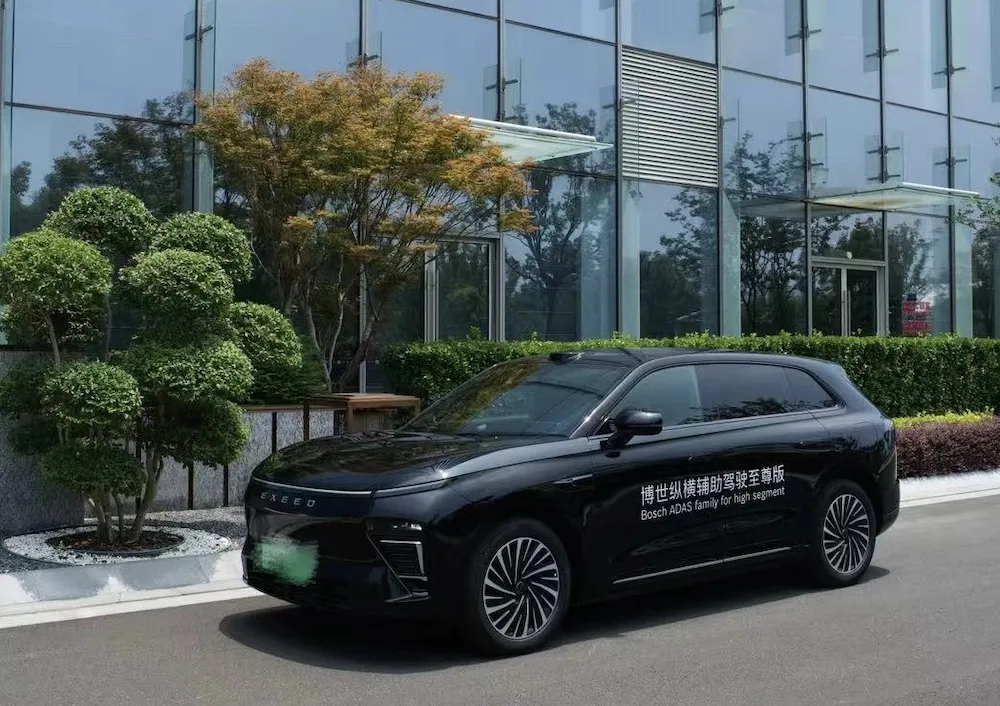
Bosch’s single-stage end-to-end test vehicle
Second is the difficulty in multimodal data acquisition and training. Multimodal data resources (such as driving scenario videos, LiDAR point clouds) are scarce, and customized data support for Chain of Thought (CoT) capabilities is needed, relying on OEMs’ data closed-loop capabilities.
It should be noted that automotive companies’ big data scale has exceeded hundred billion and trillion levels, but data collection, annotation, and training costs are enormous.
Some institutions have calculated that with a single segment annotation cost of approximately $0.86 (about 6.2 RMB), pre-training 10 times requires about 200 GPU days, costing over $6,000 (about 43,200 RMB).
Most importantly, VLA models must be deployed on smart driving chips to achieve driving safety and highly humanized driving.
According to Wu Yongqiao, VLA model scale must reach around 7B-10B (i.e., 7 billion to 10 billion parameter scale) to meet requirements, but currently almost all third-party smart driving chips on the market are not specifically designed for large model computation, with relatively small bandwidth.
NVIDIA’s Orin-Y chip has a memory bandwidth of 200GB/s and supports 200TOPS computing power, but it’s difficult to efficiently run 7B-10B parameter models, making real-time response frequency hard to achieve.
While Tesla’s FSD-used AI4 chip (approximately 700TOPS computing power) has leading performance, its bandwidth is unclear, and due to regulatory restrictions, localization adaptation faces challenges.
Actually, the landing cases of VLA technology also confirm these challenges.
DeepRoute.ai plans to launch VLA models based on Thor chips in 2025, and a leading OEM adopts an E2E+VLM dual system. VLA architecture requires 3D scene understanding and LLM retraining, relying on engineering optimizations (such as MoE, Sparse Attention) to achieve real-time inference, but there’s still time before deployment.
Currently, Li Auto, which has progressed the fastest, only delivered its first mass production version on August 20, while XPeng Motors plans to start gradual deployment in Q4.
In comparison, the retail sector has already seen VLA application cases, such as Galaxy General’s Galbot robots completing product grasping and delivery in supermarket scenarios, but the complex environment and real-time requirements in the automotive field make VLA implementation more challenging.
Regarding this, Wu Yongqiao also mentioned that Bosch recognizes VLA’s long-term potential but emphasizes that “single-stage” is more realistic at the current stage, calling for the industry to rationally view technological development and avoid blind trend-following.
02. Single-Stage End-to-End Implementation Speed is Fast – More Practical in the Short Term
Facing VLA’s short-term bottlenecks, Bosch chooses to advance the single-stage end-to-end technology route.
From the deployment situation, Bosch’s single-stage end-to-end solution based on NVIDIA Orin-Y chip (200TOPS), developed in cooperation with WeRide, entered mass production on Chery’s high-end models this year, demonstrating its pragmatic advancement approach.
Overall, this solution has three major technical advantages.
First, strong technical maturity and engineering capabilities. Bosch has over 20 years of ADAS R&D experience. Currently, Bosch Smart Mobility has nearly 18,500 employees globally, with over 1,400 employees in China, 80% of whom are R&D personnel.
Previously, Chery Exeed’s Sterra ET project took only 18 months from designation to mass production, much faster than some OEMs’ 3-5 year self-development cycles, demonstrating Bosch’s engineering efficiency.
Second, high cost controllability and mass production feasibility. Orin-Y chip costs are lower than high-end solutions, suitable for mid-to-high-end model mass production.
Bosch’s solution reduces OEM R&D costs, avoiding the high investment and low return dilemma brought by full-stack self-development.
Third, rich safety verification and high reliability. Bosch’s solution integrates BlackBerry QNX OS for Safety system, meeting automotive-grade safety standards such as ISO 26262 ASIL-D, ensuring real-time performance and reliability.
Meanwhile, on the basis of capability improvement, assisted driving functional safety is transforming from an industry “elective course” to a “required course.”
With the imminent implementation of mandatory standards such as “Safety Requirements for China’s Intelligent Connected Vehicle Combined Driving Assistance Systems,” functional safety not only affects technical development but also directly relates to product launch and corporate compliance.
Failure to meet standards may lead to project delays, cost increases, and even recalls and brand risks.
After all, certification is just the result; real safety needs to permeate the entire development process. From hardware architecture and operating systems to application logic, every link needs to meet safety requirements.
ASIL B level requires chips to have over 90% single-point failure diagnostic coverage, meaning additional hardware safety mechanisms and verification investment. Similarly, the architectural characteristics of commonly used operating systems may also bring potential risks, requiring protection at the design stage.
Industry trends show that functional safety has become a hard threshold for supply chain access. Companies can only reduce uncertainty during regulatory transition periods and ensure product safety and market competitiveness by advancing deployment in system construction, process management, and technical implementation.
In contrast, some “PPT technologies” lack automotive-grade verification and large-scale testing resources, making it difficult to guarantee mass production stability.
In practical applications, Bosch’s assisted driving solution has already demonstrated obvious advantages. Previously, Chery Exeed’s Sterra ET successfully experienced enhanced highway assistance functions with automatic lane changes in rain testing, achieving seamless transition from highways to urban areas, showing its capabilities.
Bosch’s engineering and delivery capabilities can also help OEMs achieve faster mass production.
03. Driving Experience is Key – Assisted Driving Must Avoid Zero-Yuan Competition
Based on mass production capabilities, sustainable development is also a topic worth deep research in the assisted driving industry.
Bosch believes that the current industry faces the dilemma of “increased revenue without increased profit,” with price wars intensifying, urgently needing to establish reasonable business models.
Wu Yongqiao cited National Bureau of Statistics data from June 2025, pointing out that although China’s automotive industry revenue increased 7% year-over-year from January to May this year, and passenger car sales increased 14%, the industry’s overall profit dropped significantly by 11.9%.
Under current industry competition, the 3.5% average profit margin is also thought-provoking.
This figure matches Bosch’s 2024 financial report profit margin, prompting Bosch to re-examine the development path of intelligent driving technology and how to avoid continued industry competition.
From the industry competitive landscape, Huawei and CATL have certain bargaining power and pricing ability in front of OEMs. All other Chinese automotive suppliers, including Bosch, can only face brutal price competition.

Wu Yongqiao, President of Bosch Smart Mobility China
Wu Yongqiao believes this price war has trapped the industry in a “zero-yuan competition” dilemma, unable to achieve value enhancement through technological innovation.
Wu Yongqiao said that when smart driving technology reaches ultimate performance and excellent experience, giving users extremely confident, safe, and comfortable feelings, users will inevitably be willing to pay for it, even at high prices.
Recently, Yu Chengdong, CEO of Huawei’s Smart Car Solution BU, also mentioned in a media interview that Huawei will not pursue the VLA path, focusing more on WA – World Action. He also acknowledged Bosch’s view that smart driving should be paid for during the interview.
After all, Tesla FSD and Huawei ADS’s paid models have already verified this viewpoint, showing user acceptance of technology premiums.
It can be seen that with the support of Tier 1 suppliers like Bosch with excellent mass production capabilities, combined with mature hardware platforms, they can also demonstrate late-mover advantages, carving out a path in the current “red ocean” track of assisted driving.
04. Conclusion: Bosch’s Pragmatic Implementation of Single-Stage End-to-End
The continuous advancement of single-stage end-to-end architecture is both Bosch’s deep understanding of current chip computing power and system complexity, and its adherence to “implementation capability” as the industry’s core competitiveness.
While VLA as a possible future evolution direction has both challenges and potential, it deserves continued investment but requires calm assessment.
It’s not difficult to see that among technological trends, Bosch has chosen a pragmatic route.
In future assisted driving R&D, it’s not just a competition of algorithms, but a comprehensive game of engineering, experience, and value. In this game, whoever can truly understand users, implement technology, and create value can carve out a path to the future in the red ocean.