

BYD: Domestic Racing Culture, Global Markets & 800k Overseas Sales Goal
Since the start of 2025, BYD has sparked a wave of making automotive intelligent driving a standard with its “Universal AD” initiative. In the intelligent sector, BYD’s “Divine Eye” AD system has been installed in over 1.2 million vehicles; prior to this, the number of BYD models equipped with L2-level AD had already exceeded 4 million. In other words, BYD now has a data base of over 5 million intelligent AD vehicles in China. Beyond data, BYD holds two key advantages: the world’s largest NEV production scale and the world’s largest team of intelligent driving engineers (over 5,000 people, according to Li Yunfei).
Meanwhile, BYD’s overseas strategy has entered a period of rapid growth. This year, BYD set an internal overseas export target of 800,000 units, and overseas sales reached 470,000 units in H1. Li Yunfei stated, “Exceeding 800,000 overseas sales this year should be no problem.” Three years ago, however, BYD’s monthly sales in major European countries were less than 100 units, drawing media criticism for “disgracing Chinese brands.”
In the domestic market, BYD has rolled out policies like “Universal AD” and “Parking Guarantee” to consolidate sales growth with technological advantages. From January to July 2025, BYD’s cumulative sales reached 2.49 million units, a year-on-year increase of over 27%. Recently, BYD invested RMB 5 billion in building race tracks: tracks in Zhengzhou and Hefei are already in operation, the Shaoxing track will open soon, and more all-terrain professional tracks will be built in the next three years – even an international-level track is not ruled out. At the recent Chengdu Auto Show, BYD conveyed a clear direction: fostering a domestic racing culture while expanding into global markets.

1. Will BYD’s 2025 Overseas Sales Exceed 800,000 Units?
BYD’s rapid overseas growth in recent years is built on two to three decades of preparation – many of its overseas executives have served for over 25 years. BYD’s overseas expansion has gone through three phases:
- Phase 1 (1997-1998): OEM for consumer electronics (e.g., mobile phone components for Nokia and Motorola), with overseas branches in Europe, America, and Asia-Pacific.
- Phase 2 (c.2011-2012): Overseas expansion of PV energy storage and electric buses, which can be seen in the US, London, Japan, and Singapore.
- Phase 3 (current): Passenger vehicle exports, officially launched in 2022 after preparation in 2021. Sales jumped from 50,000 units in 2021 to 240,000 in 2022, 430,000 in 2023, and 470,000 in H1 2025.
The journey was not easy. In 2022-2023, BYD’s monthly sales in Germany were less than 100 units, drawing criticism from Chinese self-media. However, BYD persisted and secured a 100,000-unit (6-year) order from Sixt, the world’s largest car rental company – a deal that shocked European media (some even opposed it publicly).
Today, BYD performs impressively in key overseas markets:
- Asia-Pacific: Ranks first in total sales (including ICE and EV) in Thailand, Indonesia, Malaysia, and Singapore. Even in Singapore, where BYD cars cost RMB 900,000-1.2 million due to “Certificate of Entitlement” policies, customers still choose BYD.
- Latin America: Fast growth in Brazil (where BYD has built a factory) and Mexico.
- Europe: Monthly sales in major markets (UK, France, Germany, Italy, Spain) now exceed 3,000 units, up from less than 100 units three years ago.
In 2023, BYD became the first Chinese brand to enter the global top 10 in 70 years of China’s auto industry (ranking 9th), rising to 6th in 2024. In terms of brand ranking, BYD placed 3rd in 2024 (after Toyota and Volkswagen). With growing acceptance of Chinese brands overseas and expanding distribution networks, BYD’s overseas growth is set to continue.
2. BYD’s AD Planning
BYD’s AD layout has been in the works for years:
- Two years ago, Denza first launched the “Divine Eye” AD system (a key starting point for BYD’s full entry into AD), followed by tech advancements at Yangwang.
- In February 2025, BYD officially released the “Universal AD” version of Divine Eye, which gained wide industry attention.
As of early July 2025, over 1.2 million BYD vehicles were equipped with its AD system, plus 4 million with L2-level AD – totaling over 5 million AD-enabled vehicles in China, forming a large-scale data base crucial for AD system training and iteration.
Backed by its large NEV production scale and 5,000+ AD engineers, BYD balances technical optimization and cost control, achieving “superior tech at lower costs.” This supports its “Universal AD” initiative, which covers three core scenarios: active safety, navigation AD, and smart parking.
Smart parking is deemed a high-potential scenario by BYD (closed, low-risk, data-rich, ideal for L4-level application). On July 9, 2025, BYD launched the industry’s first “Smart Parking Safety Guarantee Commitment”: all accidents in smart parking scenarios for Divine Eye-equipped models are covered by BYD, regardless of whether the owner is the first user or if the vehicle is out of warranty – with no upper limit on compensation.
This confidence stems from data: by early June 2025, nearly 1 million BYD AD vehicles had an accident rate of less than 1 in 1 million in smart parking scenarios, with minimal compensation costs. The policy has been well-received, with a 70% usage rate among users.

3. Why BYD is Building Race Tracks
China is the world’s largest single auto market, yet racing culture has not fully developed. For example, Hungary (population <10 million, annual car sales ~100,000, area slightly larger than Chongqing) has 21 race tracks (including one F1 track), while China has only ~20 tracks – a mismatch given its population and car ownership.
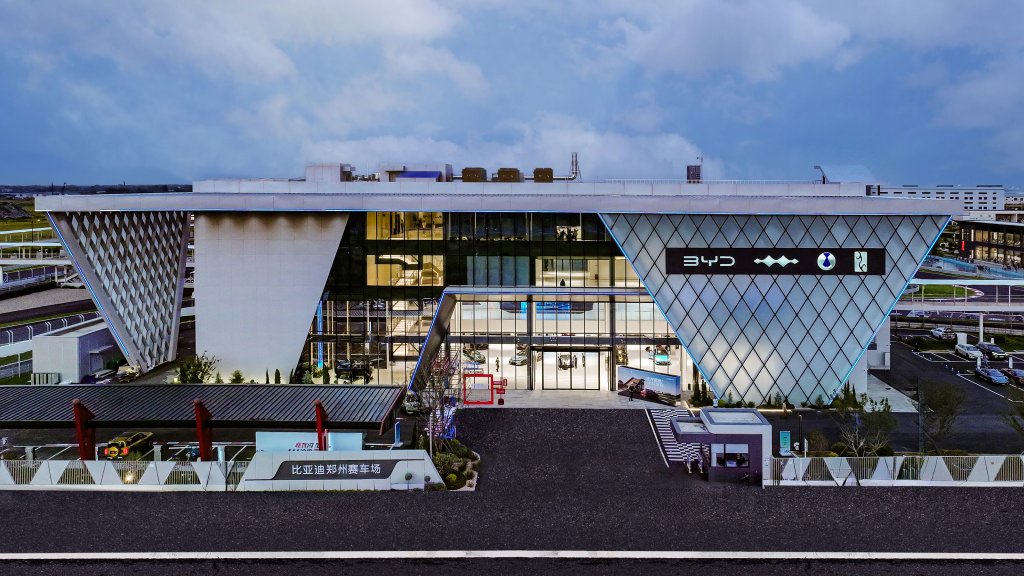
As a “national brand” with top domestic sales and global NEV leadership, BYD aims to contribute to China’s auto culture. In January 2024 (BYD Dream Day), it officially announced a RMB 5 billion investment to build the world’s first batch of all-terrain professional race tracks. To date:
- Tracks in Zhengzhou and Hefei are operational; an all-terrain off-road experience center is under construction.
- More tracks are planned for the next three years (8+ in total), with a focus on safety and fun.
BYD’s “Universal Track” initiative aligns with its “Universal AD” goal: to let more people “access tracks, have fun, and learn safely.” For example:
- The Zhengzhou track integrates new intelligent/electrified tech with traditional racing, offering experiences like low-friction road (simulating ice) for learning “vehicle rescue” in snowy weather, and “fishhook test” (high-speed emergency avoidance, once a luxury brand monopoly) – BYD vehicles pass 160-180 km/h tests with tire ground clearance <5 cm.
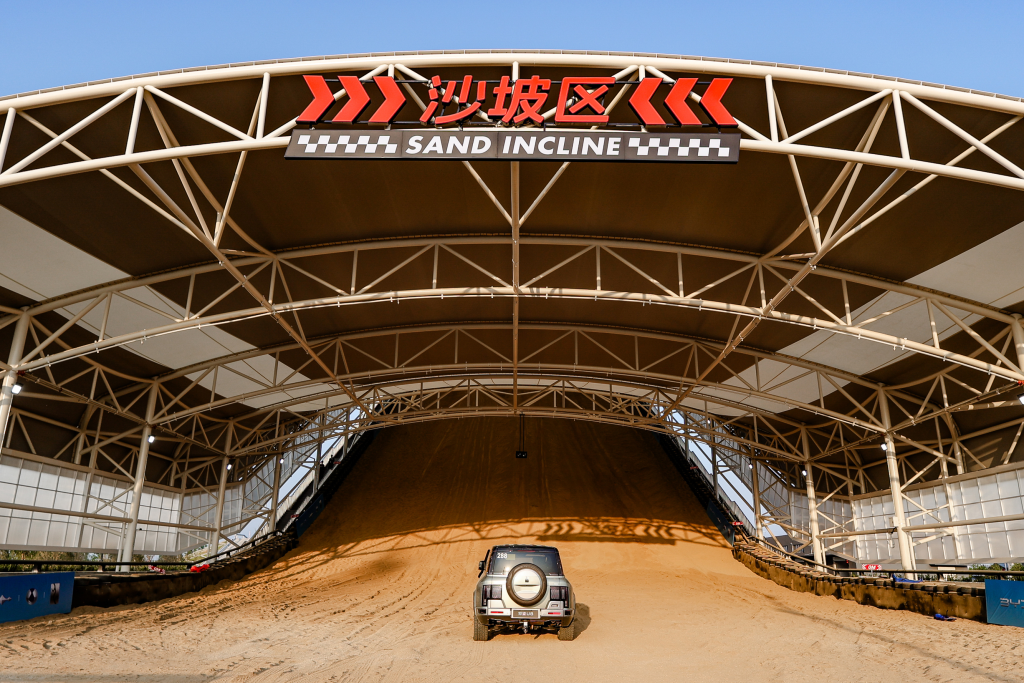
In collaboration with CAMF (China Automobile and Motorcycle Federation), BYD plans to train 100 professional racers initially, with a long-term goal of “enabling 1 million people to race.” With 1.3 million NEVs produced (expected to reach 1.4-1.5 million by Q4 2025), BYD has a large user base eager to experience racing – its strategy is to build momentum first, then upgrade hardware.
Notably, Chinese brand market share in China has risen from <35% (5-6 years ago) to 67% today – a testament to the joint efforts of Chinese automakers, with BYD playing a key role.