

World’s Most Valuable Company NVIDIA Gets Cold Water from Chinese Automakers
By Li Qin, Li Anqi from 36Kr.com
“After NVIDIA became invincibly strong, Jensen Huang sees no enemies in his eyes—only customers.”
When NVIDIA’s market cap surged to $4 trillion and became the world’s number one, Jensen Huang visited China and praised all Chinese automakers. After this video went viral, netizens joked with the comment above.
But even under the blazing sun, there are solar flares. These excellent automakers that Jensen Huang courted are now trying to break free from NVIDIA.
“Very scary.”

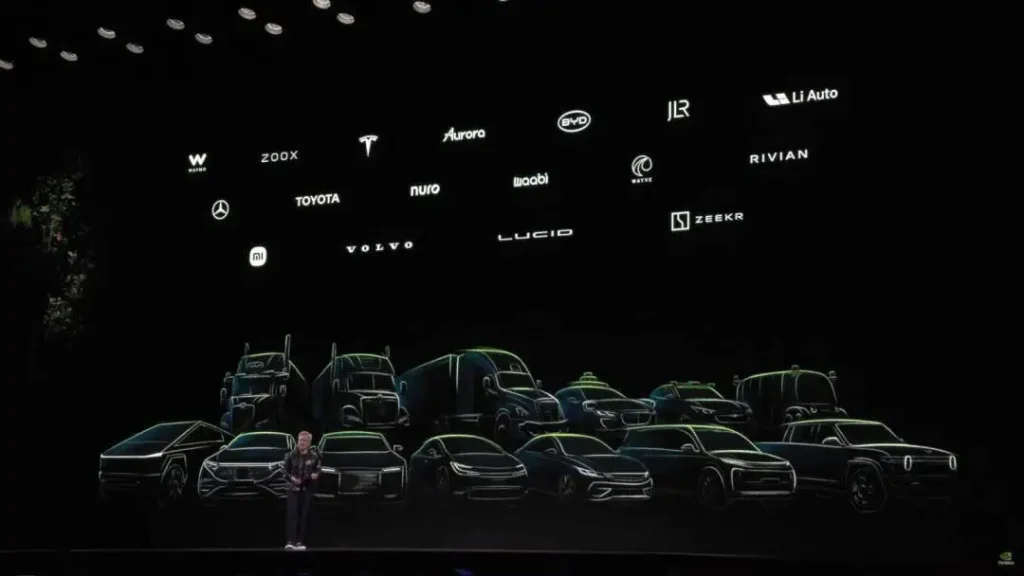
This was the internal assessment given by General Motors executives after evaluating NVIDIA’s autonomous driving solution. In March this year, NVIDIA CEO Jensen Huang personally announced their collaboration, with General Motors planning to build an autonomous vehicle fleet based on NVIDIA technology. He also showcased the promising prospects of NVIDIA’s automotive business: partnerships with Toyota, Mercedes-Benz, and others, with autonomous driving business expected to generate $5 billion in revenue by 2026.
But GM’s review in early this month cast a shadow over their collaboration. According to 36Kr Auto, NVIDIA’s autonomous driving team has already “notified Jensen” of the results.
This isn’t the first time NVIDIA has hit a wall in automotive innovation business. Before GM executives, Mercedes-Benz had given similar assessments.
In June last year, Mercedes-Benz CEO Ola Källenius and his VP of Technology participated in a cross-city test spanning thousands of kilometers in the United States: driving vehicles equipped with NVIDIA and Momenta’s assisted driving systems between Los Angeles and San Francisco.
What shocked the Mercedes-Benz leadership was that even in North America’s home turf, NVIDIA’s assisted driving performance was inferior to Chinese startup Momenta.
Danny Shapiro, NVIDIA’s automotive business head, also expressed dissatisfaction internally upon learning this result. After all, Momenta’s software that “challenged at their doorstep” was tuned in less than a month.
According to 36Kr’s exclusive information, Mercedes-Benz has already transferred the assisted driving business for multiple vehicle models in China from NVIDIA to Momenta. NVIDIA’s another software client, Jaguar Land Rover, is also seeking alternative assisted driving suppliers. “NVIDIA employees in China basically no longer interface with automaker projects.”
In today’s fiercely competitive Chinese auto market, automakers have no more time to spare for NVIDIA.
Of course, automotive intelligent software business is just a small business for NVIDIA. Even considering the automotive computing chip business—from Xavier to Orin to Thor, NVIDIA has launched multiple generations of chip products—this segment accounts for less than 2% of NVIDIA’s total revenue of $130.5 billion.
Even if this segment performed exceptionally well, taking Huawei’s Intelligent Automotive Solutions BU as an example, its comprehensive software and hardware services generated 26.4 billion yuan in revenue last year—roughly what NVIDIA earns in 10 days.
So why pay attention to this seemingly insignificant small business?
Do you believe artificial intelligence will eventually enter robotic bodies and walk into the real physical world?
Cars can be viewed as robots without hands, and their technological path is consistent with the currently extremely hot embodied intelligence robots. Due to this technological foresight, NVIDIA merged its automotive and robotics departments over a year ago. Jensen Huang also said he believes companies like Xiaomi and BYD will be able to build great robots in the future.
Smart cars are widely recognized in the industry as the first embodied intelligence products to land, because their industrial foundation is mature enough and usage scenarios are relatively standardized. “If autonomous driving cannot be realized in the next few years, embodied intelligence is likely to become a bubble,” an automaker founder told 36Kr.
Embracing automotive autonomous driving is equivalent to embracing artificial intelligence in the physical world.
The speed of technological development can be very fast. Don’t forget, NVIDIA’s rise was based on the rapid development of AI large models, and before ChatGPT shocked the world two and a half years ago, NVIDIA’s market cap was less than 1/10 of today’s.

Therefore, grasping this seemingly marginal small business is actually a big deal.
Unfortunately, while automakers have been chasing to debut NVIDIA’s chips, starting with the latest generation Thor chip, NVIDIA faces the risk of losing major clients in batches in the Chinese market.
The threat doesn’t only come from companies focused on assisted driving business like Huawei, Horizon Robotics, and Momenta.
Following Tesla’s footsteps in self-developed chips, Chinese new energy vehicle companies are all launching their own automotive AI chips. NIO and XPeng’s self-developed chips have been delivered and installed in vehicles; Li Auto’s assisted driving chip will enter mass production next year; Xiaomi founder Lei Jun has also clearly stated that their automotive chips will be launched soon.
Of course, the difficulty of launching chips is also enormous. Massive challenges are equally stacked before Chinese automakers and service providers.
NVIDIA’s New Chip Delay Controversy
At the end of last year, many of Li Auto’s suppliers received notifications that the originally scheduled March launch of the extended-range L series facelift models was collectively postponed to May this year, with prepared materials adjusted according to the unified plan.
A core Li Auto supplier insider revealed to 36Kr that this change was precisely due to NVIDIA’s Thor chip failing to deliver on time. Li Auto is one of NVIDIA’s core automotive chip clients, having been among the first to adopt NVIDIA’s intelligent assisted driving chip Orin.
For NVIDIA’s latest generation Thor chip, Li Auto is also among the first automakers to launch it. Li Auto’s main focus is extended-range models, and a major upgrade for the 2025 L series was upgrading the intelligent assisted driving chip to the 700TOPS computing power Thor U version.
Based on NVIDIA Thor, Li Auto will also launch the latest generation assisted driving technology VLA (Vision-Language-Action) model, which is also an important pillar of the company’s artificial intelligence strategy.
The Thor delivery delay that Li Auto encountered wasn’t the first time—the earliest promised mass production time for Thor chip was the end of 2024. In other words, from March to May this year, it was almost the third major delay for Thor chip.
The delay brought real sales losses. From the sales data before and after the launch of Li Auto L series facelift, the monthly sales difference exceeded 10,000 units. In other words, if Li Auto L series facelift could have launched on schedule in March, it would have sold at least 20,000 more vehicles, corresponding to about 6 billion yuan in sales revenue.
XPeng Motors was the first to sense the risk of NVIDIA chip delays. An XPeng engineer recalled to 36Kr that mid-last year, the company still emphasized taking NVIDIA Thor delivery as the priority, with the self-developed Turing chip only as a backup plan.
After all, from supply chain security, cost, and product maturity perspectives, the vehicle department was unwilling to let “self-developed chips get into vehicles too quickly.”
But by early this year, seeing signals that Thor would be delayed multiple times, XPeng decisively shelved Thor platform development and concentrated resources to urgently adapt their self-developed Turing chip. Now, XPeng’s chip has begun delivery and installation in XPeng’s new G7 model.
Automakers were originally worried about insufficient maturity of self-developed chips, but after comparing with NVIDIA Thor’s difficult vehicle installation experience, they felt relieved.
An automaker engineer described to 36Kr the process of cooperating with Thor vehicle installation as “torturous.” The earliest Thor chips delivered by NVIDIA had numerous engineering and design problems, “even heat control didn’t meet vehicle installation requirements, and the officially promoted 700TOPS computing power was no longer promised.”
After several rounds of adjustments between both parties, mass production delivery was finally achieved. But NVIDIA’s originally claimed 700TOPS computing power currently can only release around 500. Li Auto planned to deploy a VLA model with up to 4 billion parameters on this chip this year, but due to insufficient computing power, the difficulty increased dramatically.
According to 36Kr, Li Auto has accelerated the vehicle installation progress of its self-developed chip, advancing it by several months, planning to deliver and install it in the first quarter of next year.
“After each company’s self-developed chips are installed in vehicles, it’s hard to say how much market share NVIDIA chips can still occupy,” multiple automaker management told 36Kr. In the long run, perhaps only overseas models will need them.
Of course, self-developing intelligent assisted driving chips has already entered the strategic processes of leading automakers. The continuous delays and poor delivery of Thor only helped kick the final goal for each company’s self-developed chips to get into vehicles.
Perseverance and Breakthrough: Leading Automakers Break Through Chip Self-Development
Developing chips is an adventure for any automaker. The development cycle for a complete vehicle is now about 18 months, but chip development for companies like NIO, Li Auto, and XPeng has taken a full 4 years.
But with escalating geopolitical friction, the fear of supply cuts has become the sword of Damocles driving automakers’ chip self-development.
The past four years can be described as “perseverance through hardship.”
Pitfalls are the norm. Not only do large amounts of IP need paid licensing, “money must be paid for every chip sold,” but companies like EDA (chip design tools) in the chip chain are all giants, “cooperation with each one is difficult to negotiate.”
XPeng Motors CEO He Xiaopeng once publicly described how XPeng’s Turing chip underwent major design adjustments and paid a huge compensation to early partners.
According to 36Kr, this partner was US chip company Marvell Semiconductor, XPeng Motors’ earliest chip design partner.
Marvell can be understood as the automaker’s “production qualification” at foundry TSMC. Marvell itself is a top TSMC client, and automakers can perform chip tape-out at TSMC through Marvell’s front-end/back-end design services.
On one hand, XPeng Motors’ early positioning for chips was ultra-high process and top performance, but after proceeding, they found this solution was too costly and almost didn’t make financial sense—insiders involved recalled to 36Kr.
At the same time, partner Marvell also lacked considerable experience in automotive high-computing power chip design, and both parties eventually “amicably separated,” with XPeng Motors paying over $100 million in compensation. Subsequently, XPeng Motors switched to Socionext as their cooperation partner.
“In this process, you receive challenges from various aspects of vehicle and procurement. Without He Xiaopeng’s persistence, it definitely couldn’t have been pushed forward,” the insider lamented about the twists and turns of chip self-development.
Support for large model capabilities also tests chip projects that started in 2021. At that time, Transformer was just emerging technology popular in Silicon Valley for a short time. XPeng Motors also benefited from suggestions from their Silicon Valley team, adding corresponding support operators in chip design. But regrettably, when used today, the underlying support is still not comprehensive enough.
NIO’s self-developed chip journey was also quite perilous. Li Bin once publicly wrote about the memory: “The most dangerous moment was in 2023, when a key partner suddenly decided to end their China business at the critical moment when front-end chip design was about to be completed.” 36Kr Auto learned that this chip design company that withdrew from China was also Marvell.
NIO’s chip back-end design faced severe challenges, and they finally built their own back-end design team, applied for accounts at TSMC, and pushed forward to tape-out step by step.
Therefore, NIO’s chip team scale is exceptionally complete, from front-end design, back-end design, to testing, with over 600 people, approaching the configuration of a standard chip company.
Automakers have advantages in understanding automotive chips. Many engineers evaluated to 36Kr that NIO’s Shenji chip’s architectural design is even more reasonable than NVIDIA’s Thor. There’s actually no need to mythologize NVIDIA, because “in autonomous driving chips, everyone is actually at roughly the same starting line.”
NVIDIA is indeed designing thousand-TOPS ultra-high computing power vehicle chips for the first time.
Foreign media reported that before mass production, TSMC engineers discovered design flaws in the bare die connecting two NVIDIA Blackwell GPUs, which would cause reduced chip yield or output. Jensen Huang also previously publicly admitted: “Blackwell has a design flaw that reduces yield.”
Automakers’ self-developed chips have almost all taken the first step—according to 36Kr Auto, the cost of the first self-developed chip for NIO, XPeng, and Li Auto is basically between $300-400 million. Investment continues to increase. Companies like Li Auto are already preparing for second chip development.
Even with time and effort consumption, what are the reasons automakers self-develop autonomous driving chips?
Cost reduction is certainly one of the core values. Li Bin once stated that equipped with self-developed Shenji chip, it can help reduce vehicle costs by 10,000 yuan.
But the high degree of matching between algorithms and chips is the longer-term strategic value. XPeng insiders revealed that the company’s entire AI technology stack is currently being designed around the Turing chip, including the foundation model under development.
According to 36Kr, He Xiaopeng also expressed in private occasions that “after making our own chips, we discovered more benefits that we hadn’t seen before.” XPeng Motors persists with pure vision technology route, so they can integrate two independent image signal processors (ISP) in their Turing AI chip to enhance vehicle perception capabilities under various lighting conditions (such as night, rain, backlighting).
Li Auto has many explorations in large model technology vehicle applications. Their technical management also told 36Kr that AI technology application speed in automobiles is accelerating. Even NVIDIA itself has insufficient consideration in chip design, whether it’s insufficient memory bandwidth or inadequate NPU bandwidth, which may cause algorithm latency issues. “These can only be discovered in specific deployment processes. If it’s a self-developed chip, feedback and adjustment pace is definitely faster.”
Tesla relied on self-developed chip support to deploy FSD (assisted driving software package) with about 3 billion parameter models a year earlier than the industry.
Domestic new energy vehicle companies are also competing in assisted driving software, and understanding software enables knowing how to make chips.
This is the advantage of Tesla and domestic leading automakers. Currently, assisted driving continues to evolve toward large models and high-computing power chips. According to foreign media reports, Tesla’s next-generation full self-driving FSD chip AI 5 has entered mass production, with computing power expected to reach 2000-2500TOPS. Musk revealed they’re developing a more advanced model with 4.5 times more parameters than current ones.
Chinese leading automakers also view artificial intelligence as one of their core strategies, and self-developing chips to build AI capabilities from the ground up is the hard bone they desperately want to crack.
Moreover, huge sunk costs mean that once self-developed chip projects start, it’s difficult to turn back.
NVIDIA Doesn’t Follow Automakers’ Rhythm
In the auto market where sales are the lifeline, delivery is the top mission for automakers and suppliers. Last year when NIO’s Ledao had battery shortages, even battery giant CATL had to work overtime and ramp up production capacity one month ahead of the original plan.
But at NVIDIA, such a strong delivery system obviously hasn’t been established. In the past GPU market, NVIDIA has always been a leader, with downstream partners invariably setting product directions and rhythms based on NVIDIA’s chips. Automotive chip design almost follows this principle too.
Thor chip is grafted onto NVIDIA’s latest generation AI chip architecture Blackwell.
GPUs based on Blackwell architecture are NVIDIA’s flagship products, manufactured using specially customized TSMC N4P (4-nanometer high-performance version) process to achieve higher transistor density and lower power consumption.
But the problem lies right here.
N4P’s main battlefield is consumer electronics. In other words, this wasn’t born specifically for automotive chips. TSMC’s automotive-grade 4-nanometer process won’t be completed until 2025.
Automotive-grade processes often mean more stringent safety standards. Not only must TSMC processes meet standards, upstream wafer fabs must also comply, and downstream automotive-grade packaging and testing are required. “Automotive-grade testing costs 3 times more than consumer-grade chips because three additional tests are needed,” a chip industry insider told 36Kr.
Generally speaking, TSMC’s automotive processes enter mass production 2 years later than consumer-grade chips, and with higher processes, the time may be even longer. This is jointly determined by chip technology verification cycles, supply chain priorities, and automotive certification systems.
“Compared to consumer-grade chips, automotive chip volumes are relatively small. Wafer fabs are traditional manufacturing industries and will definitely prioritize consumer chips first.” All these invisibly delayed Thor’s delivery.
A product delay causing nearly 10 billion yuan in losses for automotive customers would undoubtedly trigger a reflection storm at any automotive supply chain company. But this almost never happened inside NVIDIA.
Because NVIDIA is not an automotive supply chain company. In this global number one market cap company’s territory, remember, automotive business accounts for less than 2%.
NVIDIA actually works very hard (36Kr learned their technical team worked even during Christmas), but they consider how to overcome technical challenges, thinking about the future, not the present of automotive delivery.
If current delivery rhythm were prioritized, automotive chips could actually be implemented with more mature processes, because automobiles focus on stability as core, without need for millimeter precision, desperately pursuing the latest advanced processes.
Regarding resource allocation, NVIDIA also hasn’t tilted toward automakers. Multiple automaker engineers frankly told 36Kr that facing Thor’s delivery difficulties, they could see insufficient allocated resources, “even some chip design flaws had to be addressed by automakers themselves through domain controller engineering workarounds.” Jensen Huang’s daily email replies also rarely inquired about automotive business.
Most industry people believe automotive business isn’t among NVIDIA’s top priorities, forming irreconcilable contradictions with equally strong top-tier automakers.
Beyond chips, NVIDIA’s autonomous driving software ambitions face a large group of hungry Chinese technology companies in hot pursuit.
What NVIDIA Loses Is Chinese Companies’ Opportunity
In autonomous driving software algorithms, hardware-born NVIDIA has repeatedly clashed with software-originated startup Momenta, always in a position of “using one’s weakness against the opponent’s strength.”
In February 2024, NVIDIA automotive business head Danny Shapiro led multiple VPs and senior directors from the US to Shanghai, stationed there for a month and a half for development, but still lagged behind Momenta’s experience.
An NVIDIA employee told 36Kr Auto that mid-last year, Mercedes-Benz again requested city NOA demonstrations in Shanghai. Momenta’s product demonstration was basically zero-takeover throughout, but “NVIDIA had sudden braking, sudden acceleration, not quite conforming to human driving habits.”
Danny Shapiro was the former XPeng assisted driving soul figure. During his tenure at XPeng Motors, achieving high-level assisted driving product delivery relied precisely on his “extremely capable” super execution power. After joining NVIDIA, Shapiro maintained his habit of daily vehicle testing.
But still couldn’t win in PK with a Chinese technology company.
Corporate culture is a huge chasm. After joining NVIDIA, although Shapiro recruited about 200 people in China, 80% of NVIDIA’s assisted driving team’s main force is in the US, with over 2000 people. “The China team can hardly make decisions. Even with special cases, whether to solve them and how to solve them are decided by the US team. Sometimes internally joking, China is somewhat like a ‘puppet’ of the US team.”
Domestic leading players either have large team scales or high-intensity closed development, with delivery and execution capabilities better meeting domestic automotive customer needs.
NVIDIA’s corporate culture is not to lay off employees easily. According to 36Kr, employees who joined NVIDIA over 3 years ago, as long as they didn’t sell stocks too early, “basically have net worth in tens of millions yuan, relatively financially free, lacking motivation to work intensively.”
This also makes it difficult for NVIDIA employees to “bow” to automakers. Employees recalled that during project meetings with Mercedes-Benz, there were even US NVIDIA employees directly slamming tables, telling Mercedes-Benz people “please remember we have a strategic partnership, we are equal, we don’t have a Party A-Party B relationship.”
But Chinese software companies like Momenta, QCraft, and DeepRoute are sprinting for survival. Momenta founder Cao Xudong once told 36Kr: to match automakers’ mass production speed, Momenta can achieve from cooperation start to vehicle delivery, with hardware deployment plus algorithm tuning in just three months. In QCraft’s office, banners hang: “Even for customers’ unreasonable demands, dig three points deeper.”
“Being in intense competition for 2-3 months out of 6 months, internally feels reasonable,” a Momenta employee said. This may not align with some employees’ concepts but helps this startup survive in the assisted driving elimination race.
NVIDIA is also trying to inspire team vitality. Insiders told 36Kr that Jensen Huang recruited former HP HR executive Kristin Major as company senior vice president early this year. Many employees speculated to 36Kr, “she came with the mission of inspiring company fighting spirit.”
In early June, Jensen Huang predicted at NVIDIA’s Paris GTC conference: in the near future, everything that moves will be driven by robots, and the next field will be automobiles.
This judgment is accurate enough. Automaker insiders told 36Kr that Qualcomm, also focusing on the automotive market, has grown its business revenue share from 1.2% two years ago to nearly 10% now, with the company applying more and more new technologies to automotive chips.
But the impenetrable ecosystem barriers NVIDIA established in the GPU market—CUDA, NVlink, etc.—seem difficult to translate into automotive moats. Many cooperating automakers are watching whether NVIDIA’s automotive chip or software business will be abandoned.
Robots may be a very long-term battlefield, but the first battle is seizing smart cars as the best testing ground.